Impact Factor ISSN: 1449-1907




Int J Med Sci 2026; 23(12):3718-3725. doi:10.7150/ijms.140104 This issue Cite
Research Paper
Sleep Quality and Sleepiness among Nursing Shift Workers: A Correlation and Mediation Analysis of Depression, Fatigue, and Attention
Chi-Jen Wu1,2,14, Kai-Fu Chang3,4, Hui-Ru Lin2,5, Yun-Yi Wang6, Chia-Huei Lin7, Hung-Yuan Cheng8, Chung-Bao Hsieh9,10, Yung-Kuo Lee3,4,5,11  , Bih-O Lee1,12,13,14
1. College of Nursing, Kaohsiung Medical University, Kaohsiung, 80708, Taiwan.
2. Nursing Department, Kaohsiung Armed Forces General Hospital, Kaohsiung 80284, Taiwan.
3. Medical Laboratory, Medical Education and Research Center, Kaohsiung Armed Forces General Hospital, Kaohsiung 80284, Taiwan.
4. Division of Experimental Surgery Center, Department of Surgery, Tri-Service General Hospital, National Defense Medical University, Taipei City, Taiwan.
5. Institute of Medical Science and Technology, National Sun Yat-sen University, Kaohsiung 80424, Taiwan.
6. Department of Nursing, Pingtung Branch of Kaohsiung Armed Forces General Hospital, Kaohsiung, Taiwan.
7. Department of Nursing, National Defense Medical College, Taipei City 114201, Taiwan.
8. Department of Population Health Sciences, Bristol Medical School, University of Bristol, 39 Whatley Road, Bristol BS8 2PS, UK.
9. Division of General Surgery, Department of Surgery, Kaohsiung Armed Forces General Hospital, Kaohsiung 80284, Taiwan.
10. Division of General Surgery, Department of Surgery, Tri-Service General Hospital, Taipei 114202, Taiwan.
11. School of Medicine, National Defense Medical University, Taipei, 11490, Taiwan.
12. Graduate Institute of Medicine, Kaohsiung Medical University, Kaohsiung, Taiwan.
13. Center for Medical Education and Humanizing Health Professional Education, Kaohsiung Medical University.
14. Department of Nursing, Chung Hwa University of Medical Technology, Tainan, Taiwan.
Received 2026-6-30; Accepted 2026-9-23; Published 2026-11-13
Abstract
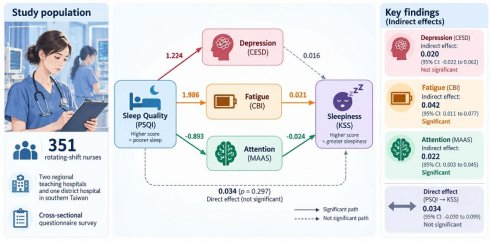
Objective: This study investigated the impact of shift work on nurses' sleep quality, sleepiness, fatigue, attention, and depression levels, with findings relevant to healthcare professionals, researchers, and policymakers.
Methods: This cross-sectional questionnaire survey collected basic demographic information and five scales: the Pittsburgh Sleep Quality Index (PSQI), the Karolinska Sleepiness Scale (KSS), the Copenhagen Burnout Inventory (CBI), the Mindful Attention Awareness Scale (MAAS), and the Center for Epidemiologic Studies Depression Scale (CESD). A total of 351 clinical rotating-shift nurses from two regional teaching hospitals and one district hospital in southern Taiwan were recruited through convenience sampling.
Results: Sleep quality was positively correlated with depression, fatigue, and sleepiness, and negatively correlated with attention. Mediation analysis showed that sleep quality was directly associated with depression, fatigue, and attention. After controlling for demographic covariates, the association between sleep quality and sleepiness was statistically explained through fatigue and attention.
Conclusion: Among shift-working nurses, poor sleep quality was not directly associated with sleepiness in this cross-sectional model; rather, the association was statistically explained through both fatigue and attention. To mitigate the harms of shift work, reasonable working hours, health education, thoughtful scheduling, and at least three rest days are recommended.
Keywords: nursing shifts, sleep quality, sleepiness, fatigue, attention, depression, mediation analysis
Introduction
In Taiwan, shift work falls under the regulatory purview of the Ministry of Labor, and several studies have examined how common insufficient sleep and poor sleep quality are among Taiwanese shift workers [1-3]. Night shift workers in particular appear to carry the highest risk of both problems, underscoring how strongly shift work shapes sleep-related outcomes [1, 4].
Shift work is integral to healthcare delivery, particularly in nursing, where continuous patient care is required around the clock [5-8]. Yet it also comes with real costs: shift work has been linked to disrupted circadian rhythms, poorer sleep quality, increased fatigue, and mental health problems such as depression and anxiety [6, 9, 10]. Given these risks, healthcare organizations have a clear incentive to support nurses working non-traditional hours and to prioritize their mental health.
Shift work can give rise to psychosocial stressors that contribute to depression and affect the psychological state and quality of life of health workers [11-13]. Awareness of these issues is crucial to addressing them effectively and ensuring the well-being of healthcare providers, who play a critical role in patient care. For nurses specifically, pinpointing which of these factors drives depression and fatigue could help shape more targeted strategies to protect their mental health [14, 15].
By recognizing these factors, healthcare providers can implement targeted interventions to support the mental health and well-being of nurses working non-traditional hours [16, 17], with downstream benefits for patient care and the broader work environment as well. Despite this growing body of evidence, most prior studies have examined these variables individually or in bivariate associations, without testing the specific pathways through which poor sleep quality translates into greater pre-shift sleepiness. The present study addresses this gap by applying a parallel multiple mediator model to simultaneously test whether depression, fatigue, and attention mediate the cross-sectional association between sleep quality and sleepiness among clinical rotating-shift nurses in Taiwan. Identifying which pathway carries the strongest statistical association can help prioritize occupational health interventions in this population.
Methods
Data collection
A cross-sectional questionnaire survey was conducted to examine the statistical associations among sleep quality, depression, fatigue, attention, and sleepiness in rotating-shift nurses. Data were collected from January to March 2022 at two regional teaching hospitals and one district hospital in southern Taiwan. Questionnaires were distributed by research team members in person at each ward, Monday through Friday, and collected on site after completion before the start of the evening or night shift. A research team member introduced the study purpose and procedures, obtained written informed consent, and collected completed questionnaires. A pilot test with five shift nurses confirmed questionnaire comprehensibility before formal data collection began. All 351 questionnaires distributed were completed and met inclusion criteria, yielding a response rate of 100%.
Sample size was estimated a priori using G*Power based on a regression and correlation framework. Assuming a medium effect size (f² = 0.15), α = 0.05, and statistical power of 0.80, the planned minimum sample size was 270 participants. To allow for potential loss of eligible or complete responses, the target recruitment sample was set at 351 participants. Nurses were eligible if they (1) had been employed for at least six months, (2) had worked at least two night-shift types in the preceding month, and (3) provided written informed consent. Nurses were excluded if they held supervisory positions, were not assigned to rotating shifts, worked in outpatient, operating room, anaesthesia/recovery, psychiatric day ward, or haemodialysis units, performed non-clinical roles, or were taking psychotropic medications other than sleep aids.
Ethics approval
Written informed consent was obtained from all study participants. All procedures were approved and monitored by the Institutional Review Board of Kaohsiung Armed Forces General Hospital (KAFGHIRB 110-010) in accordance with ethical standards and the 1964 Helsinki Declaration.
Study design
This study examined whether the association between sleep quality and sleepiness was statistically explained through depression, fatigue, and attention among shift-working nurses. The research hypotheses are as follows.
- The association between sleep quality and sleepiness among shift-working nurses is statistically explained through depression.
- The association between sleep quality and sleepiness among shift-working nurses is statistically explained through fatigue.
- The association between sleep quality and sleepiness among shift-working nurses is statistically explained through attention.
Research framework
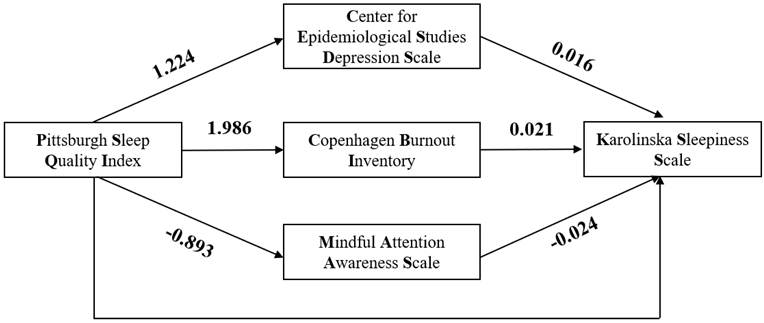
The model of this study included five variables: one independent variable (sleep quality, measured by PSQI [18]), three mediating variables (depression measured by CESD [19], fatigue measured by CBI [20], and attention measured by MAAS [21, 22]), and one dependent variable (degree of sleepiness, measured by KSS [23]). For the CBI, both the Personal Burnout subscale (5 items assessing general physical and emotional exhaustion) and the Work-related Burnout subscale (5 items assessing exhaustion attributed to work demands) were administered and summed to form the fatigue composite score used in the analyses. The research framework is depicted in Figure 1.
Cross-sectional associations between sleep quality (PSQI) and sleepiness (KSS) through depression (CESD), fatigue (CBI), and attention (MAAS) in shift-working nurses. Path coefficients are unstandardized regression coefficients. The direct path from PSQI to KSS (coeff = 0.034, p = 0.297) was not statistically significant. Standard errors, t-values, and bootstrap 95% confidence intervals for all path coefficients are reported in Table 3.
Statistical analysis
Returned questionnaires were screened, and any that were incomplete, ambiguous, or inconsistently answered were excluded. Data were analyzed using IBM SPSS Statistics, version 22.0, which was suited to the research objectives and assumptions. Descriptive statistics were used to summarize the demographic data and main study variables (sleep quality, sleepiness, fatigue, attention, and depression). Regression analysis and correlation tests were used to examine the relationships among variables and to test the proposed hypotheses. Mediation analysis was performed using the PROCESS macro, version 3.5, parallel multiple mediator model (Model 4). Given the cross-sectional design, all analyses examine statistical associations consistent with a mediation model and do not establish temporal precedence or causation. All regression and mediation models controlled for age, marital status, work experience, daily working hours, and commute distance as covariates.
Results
Demographic characteristics of the participants
A total of 351 participants were enrolled in the study. Of these, 333 participants (94.87%) were women. Regarding age, 161 participants (45.87%) were aged 20-29 years, and 98 (27.92%) were aged 30-39 years; together, these two age groups accounted for approximately 74% of the study population. Table 1 summarizes the demographic and occupational characteristics of the participants. Among the participants, 143 (40.74%) were married, and 282 (80.34%) had a college/university education. More than half of the participants, 195 (55.56%), had a commute time of 15 minutes or less, while 240 (68.38%) worked in medical or surgical wards. In terms of clinical experience, 230 participants (65.53%) had ≤10 years of experience. In addition, 216 participants (61.54%) worked ≤9 hours per day.
General characteristics of the participants.
| Variable | Number of participants (n) | Percentage (%) |
|---|---|---|
| Gender | ||
| Men | 18 | 5.13 |
| Women | 333 | 94.87 |
| Age | ||
| 20-29 years | 161 | 45.87 |
| 30-39 years | 98 | 27.92 |
| ≥ 40 years | 92 | 26.21 |
| Marital status | ||
| Unmarried | 208 | 59.26 |
| Married | 143 | 40.74 |
| Education level | ||
| Below college | 69 | 19.66 |
| College/university | 282 | 80.34 |
| Workplace | ||
| Medicine and surgery | 240 | 68.38 |
| Intensive care unit and emergency department | 111 | 31.62 |
| Number of years of work experience | ||
| ≤ 10 years | 230 | 65.53 |
| > 10 years | 121 | 34.47 |
| Commute time (min) | ||
| 5-15 | 195 | 55.56 |
| ≥ 16 | 156 | 44.44 |
| Daily working (hours) | ||
| ≤ 9 | 216 | 61.54 |
| > 9 | 135 | 38.46 |
Correlations among sleep quality, sleepiness, depression, fatigue, and attention
Table 2 shows the correlation matrix for total scores on the PSQI, CESD, CBI, MAAS, and KSS. PSQI scores showed a positive correlation with CESD scores (r = .49, P < .001), CBI scores (r = .42, P < .001), and KSS scores (r = .17, P < .001). CESD scores were positively correlated with CBI scores (r = .62, P < .001) and KSS scores (r = .30, P < .001). CBI scores and KSS scores were also positively correlated (r = .33, P < .001).
Correlation analysis of research variables about sleep quality (PSQI), the mediating variables (CESD, CBI, and MAAS), and the dependent variable (KSS).
| Sample statistic | Pearson correlation | |||||||
|---|---|---|---|---|---|---|---|---|
| N | Mean | Std Dev | PSQI | CESD | CBI | MAAS | KSS | |
| PSQI | 351 | 7.22 | 3.12 | 1.00 | ||||
| CESD | 351 | 14.25 | 7.63 | .49 | 1.00 | |||
| CBI | 351 | 48.4 | 14.74 | .42 | .62 | 1.00 | ||
| MAAS | 351 | 70.63 | 9.52 | -.31 | -.55 | -.47 | 1.00 | |
| KSS | 351 | 5.08 | 1.72 | .17 | .30 | .33 | -.26 | 1.00 |
In contrast, negative correlations were found between PSQI and MAAS scores (r = -.31, P < .001), CESD and MAAS scores (r = -.55, P < .001), and CBI and MAAS scores (r = -.47, P < .001). MAAS scores and KSS scores were also negatively correlated (r = -.26, P < .001). These results suggest that poorer sleep quality (i.e., a higher PSQI score) was significantly associated with greater depression, fatigue, and sleepiness, and with lower attention.
Cross-sectional associations of sleep quality with sleepiness through depression, fatigue, and attention
Table 3 shows the regression results for the effects of sleep quality (PSQI) on sleepiness (KSS) through depression (CESD), fatigue (CBI), and attention (MAAS). Significant effects were found between the independent variable (PSQI) and CESD, CBI, and MAAS. In addition, the effects of CBI and MAAS on KSS were significant. However, the effects of PSQI and CESD on KSS were nonsignificant, as their 95% CIs contained zero.
Significant tests of regression coefficients showing the relationships between the independent variable (IV) sleep quality (PSQI), the mediating variables (CESD, CBI, and MAAS), and the dependent variable (KSS).
| Significant test of parameters | Bootstrap 5000 times CI | R2 | ||||||
|---|---|---|---|---|---|---|---|---|
| coeff | se | t | p | LLCI | ULCI | |||
| CESD | constant | 4.877 | 1.865 | 2.614 | 0.009 | 1.221 | 8.533 | 0.279 |
| PSQI | 1.224 | 0.115 | 10.614 | 0.000 | 0.998 | 1.450 | ||
| CBI | constant | 27.642 | 3.684 | 7.503 | 0.000 | 20.421 | 34.862 | 0.247 |
| PSQI | 1.986 | 0.228 | 8.721 | 0.000 | 1.540 | 2.433 | ||
| MAAS | constant | 77.875 | 2.591 | 30.050 | 0.000 | 72.795 | 82.954 | 0.106 |
| PSQI | -0.893 | 0.160 | -5.575 | 0.000 | -1.207 | -0.579 | ||
| KSS | constant | 6.018 | 1.057 | 5.691 | 0.000 | 3.945 | 8.090 | 0.171 |
| PSQI | 0.034 | 0.033 | 1.046 | 0.297 | -0.030 | 0.099 | ||
| CESD | 0.016 | 0.016 | 1.003 | 0.317 | -0.016 | 0.048 | ||
| CBI | 0.021 | 0.008 | 2.661 | 0.008 | 0.006 | 0.036 | ||
| MAAS | -0.024 | 0.011 | -2.208 | 0.028 | -0.046 | -0.003 | ||
Note: All models control for age, marital status, work experience, daily working hours, and commute distance. Bold = significant (p < .05).
For the mediation analysis, we employed a bootstrapping method (with N = 5,000 bootstrap resamples) to test the mediating effects. A mediating effect was considered statistically significant when the 95% confidence interval (CI) did not contain zero. In Table 4, t-values and p-values for indirect effects are provided as supplementary output from PROCESS; the bootstrap 95% CI is the primary inferential criterion, consistent with standard practice for Model 4 mediation reporting.
Significant results for direct and indirect effects between sleep quality (PSQI), the mediating variables (CESD, CBI, and MAAS), and the dependent variable (KSS).
| Effect | BootSE | t | p | BootLLCI | BootULCI | ||
|---|---|---|---|---|---|---|---|
| Total effect | 0.118 | 0.029 | 4.039 | 0.000 | 0.061 | 0.175 | |
| Indirect effect 1 | PSQI→CESD→KSS | 0.020 | 0.022 | 0.927 | 0.354 | -0.022 | 0.062 |
| Indirect effect 2 | PSQI→CBI→KSS | 0.042 | 0.017 | 2.442 | 0.015 | 0.011 | 0.077 |
| Indirect effect 3 | PSQI→MAAS→KSS | 0.022 | 0.011 | 2.004 | 0.045 | 0.003 | 0.045 |
| Direct effect | PSQI→KSS | 0.034 | 0.033 | 1.046 | 0.297 | -0.030 | 0.099 |
Note: All models control for age, marital status, work experience, daily working hours, and commute distance. Bold = significant.
For indirect effects, significance is determined by the 95% bootstrap CI not containing zero; t and p are provided as supplementary descriptives.
Cross-sectional indirect associations of sleep quality with sleepiness via depression, fatigue, and attention
Table 4 shows the total, direct, and indirect effects of sleep quality on sleepiness through depression, fatigue, and attention. We employed a bootstrapping method (with N = 5,000 bootstrap resamples) to assess the indirect effects [24]. After controlling for demographic covariates (age, marital status, work experience, daily working hours, and commute distance), indirect effect 2 (PSQI → CBI → KSS) and indirect effect 3 (PSQI → MAAS → KSS) were both significant, as their 95% CIs did not contain zero ([0.011, 0.077] and [0.003, 0.045], respectively). Indirect effect 1 (PSQI → CESD → KSS) was not statistically significant (95% CI: [-0.022, 0.062]).
Discussion
Several demographic characteristics were linked to sleep quality, fatigue, attention, depression, and sleepiness among the shift-working nurses in our sample. Nurses with less than a college education, for example, had poorer sleep quality than those with a college degree or higher [25], consistent with reports that better-educated individuals tend to understand and manage their physiological rhythms more effectively. College-educated nurses may also be better equipped to manage the physical and mental toll of their work, which could translate into better sleep. At the same time, nurses with less education may face added stress while still developing their professional skills, and this added stress could itself erode sleep quality [26]. Findings on this point are not entirely consistent, however: other studies report the opposite pattern, with higher education linked to poorer sleep because of greater self-imposed expectations and stress [27, 28].
Married nurses also reported poorer sleep quality than their unmarried colleagues. One possible explanation is that women, who made up the vast majority of this sample, often carry the bulk of family and childcare responsibilities; the resulting burden, compounded by shift work, may take a toll on sleep [26]. The same juggling of family and work demands may also help explain the elevated fatigue and sleepiness seen across this group.
Shift work is known to cause changes in metabolism and personal eating habits, leading to physiological issues such as obesity, diabetes, cardiovascular diseases, and cancer [29, 30]. These changes can reduce quality of life and indirectly contribute to negative emotions and depression.
Commuting distance mattered too: nurses with a commute longer than 15 minutes had poorer sleep quality than those living closer to work, echoing a Swedish study that linked longer commutes to worse sleep [31]. Years of clinical experience told a different story: nurses with fewer than ten years on the job actually slept better than their more senior colleagues, perhaps because growing seniority brings heavier workloads and more complex interpersonal demands that can themselves disrupt sleep [26].
Extended work hours or overtime can lead to sleep problems and poor recovery, resulting in cumulative fatigue [32], partly because the long hours leave little time for leisure, exercise, or family life — all of which can foster negative emotions over time [33]. Taken together, these factors converge in what has been termed shift work disorder — a cluster of poor sleep quality, depression, fatigue, and heightened sleepiness that, together, work against sustained attention [34].
Overall, the cross-sectional mediation model, controlling for age, marital status, work experience, daily working hours, and commute distance, suggests that the association between sleep quality and sleepiness was explained through both fatigue and attention, but not through depression: although sleep quality was significantly associated with all three mediators, only fatigue (CBI) and attention (MAAS) showed significant associations with sleepiness. These findings are consistent with both fatigue management and attention enhancement being potentially important targets for reducing pre-shift sleepiness among shift-working nurses, though longitudinal studies are needed to confirm directionality. Furthermore, it should be noted that fatigue and sleepiness share considerable operational overlap and may exhibit bidirectional or reciprocal relationships: greater sleepiness can itself exacerbate perceived fatigue, and accumulated fatigue may heighten subsequent sleepiness. The present cross-sectional design cannot disentangle this directionality, and future longitudinal or ecological momentary assessment studies would be better positioned to clarify the temporal sequence between these constructs. More broadly, mitigating the harms of shift work will likely require reasonable working hours, health education, thoughtful scheduling, and at least three rest days. These findings are broadly consistent with prior studies in nursing populations. Cheng et al. similarly reported that burnout mediated the association between shift work disorder and mental health problems among nurses [5]. Consistent with this, Dai et al. found that poor sleep quality was significantly associated with greater depressive symptoms among Chinese night-shift nurses [13]. In the present sample, however, although sleep quality was significantly associated with depression (CESD), the CESD→KSS pathway was not statistically significant, suggesting that the association between sleep quality and sleepiness may be more proximally explained through fatigue and attention rather than through depression.
Limitations
Due to time and manpower constraints, the study utilized a cross-sectional survey and descriptive correlational research design. Convenience sampling was employed to collect data from nursing staff working three shifts at two regional teaching hospitals and one district hospital in southern Taiwan. This design only allows for assessing the relationships between sleep quality, sleepiness, fatigue, attention, and depression at a single point in time, without the capability for long-term, continuous evaluation of these variables at different time points.
The correlational research design used in this study does not establish causal relationships between clinical shift work patterns and sleep quality, sleepiness, fatigue, attention, and depression. The convenience sampling method also raises concerns about the validity of the inferred results, as it may not represent the broader population. Another limitation is the reliance on self-report scales to understand the current status of shift work disorder among clinical nursing staff, which lacks physiological indicators that could enhance the study's validity. Additionally, the KSS was administered immediately before the evening or night shift, capturing pre-shift sleepiness rather than sleepiness experienced during clinical duties. Pre-shift sleepiness may differ from on-shift sleepiness, which is further modulated by circadian nadirs and work demands; readers should interpret the findings in this operational context.
The reliance on convenience sampling within two regional teaching hospitals and one district hospital in southern Taiwan limits the generalizability of these findings. Nurses in different hospital levels, specialties, or geographic regions may differ systematically in their shift work patterns, sleep quality, and fatigue burden. Selection bias is also possible, as nurses who were absent, on leave, or unwilling to participate during data collection are not represented in the sample. Future studies should employ probability-based sampling across a broader range of hospital types and regions to improve representativeness.
As all study variables were assessed using self-report questionnaires administered at a single time point, common method bias is a potential concern. Procedural remedies such as temporal separation of measures were not employed, and statistical checks such as Harman's single-factor test were not conducted. Future studies should consider incorporating objective measures — such as actigraphy for sleep or psychomotor vigilance tasks for attention — to complement self-report instruments.
Conclusion
Both domestic and international studies have confirmed that shift workers are prone to developing shift work disorders, which affect their physical and mental health. Building on this, our model examined how sleep quality relates to depressive emotions, fatigue, attention, and sleepiness among shift-working nurses. In this cross-sectional model, controlling for demographic covariates, sleep quality was not directly associated with sleepiness; rather, its association with sleepiness was statistically explained through both fatigue and attention. Longitudinal studies are needed to determine the temporal direction of these relationships.
Acknowledgements
We would like to acknowledge Yi-Ting Wu, Chien-Cheng Chao, Yun-Yu Lin and Yueh-Yuan Shieh for their excellent technical support at Laboratory of Research and Medical Education and Research Center, Kaohsiung Armed Forces General Hospital.
Funding
This research was funded by Kaohsiung Armed Forces General Hospital (grant number KAFGH_D_113018), Zuoying Armed Forces General Hospital (grant number 806ZB110264), and the National Science and Technology Council (NSTC) of Taiwan (grant number 113-2320-B-393-001).
Ethics approval
The study was conducted in accordance with the Declaration of Helsinki, and was approved by the Institutional Review Board of Kaohsiung Armed Forces General Hospital (KAFGHIRB 110-010).
Data availability statement
The data used to support the findings of this study are available from the corresponding author upon reasonable request.
Authorship contribution statement
Chi-Jen Wu: Conceptualization, methodology, software, formal analysis, resources, writing-original draft preparation, writing-review and editing
Kai-Fu Chang: Conceptualization, methodology, software, formal analysis, resources, writing-original draft preparation, writing-review and editing
Hui-Ru Lin: Conceptualization, methodology, software, formal analysis
Yun-Yi Wang: Conceptualization, methodology, software, formal analysis
Chia-Huei Lin: Conceptualization, methodology, software, formal analysis
Hung-Yuan Cheng: Conceptualization, methodology, software, formal analysis
Chung-Bao Hsieh: Conceptualization, methodology
Yung-Kuo Lee: Conceptualization, resources, writing-original draft preparation, writing-review and editing
Bih-O Lee: Conceptualization, writing-review and editing
All authors have read and agreed to the published version of the manuscript.
Declaration of AI and AI-assisted technologies in the writing process
During the preparation of this work, we used AI-assisted technologies to improve the readability and language of the Introduction, Discussion, and Conclusion sections. The AI tool was not used in data analysis, interpretation of results, or generation of scientific conclusions. After using this tool, we reviewed and edited the content as needed and take full responsibility for the content of the publication.
Competing Interests
The authors have declared that no competing interest exists.
References
1. Cheng W-J, Cheng Y. Night shift and rotating shift in association with sleep problems, burnout and minor mental disorder in male and female employees. Occupational and environmental medicine. 2017;74:483-8
2. Lin CY, Su SB, Hu YT, Peng CJ, Chen KH, Chen KT. Prevalence and risk factors associated with poor sleep among firefighters in Taiwan: An observational study. Medicine (Baltimore). 2022;101:e31570
3. Huang Q, Tian C, Zeng X-T. Poor sleep quality in nurses working or having worked night shifts: A cross-sectional study. Frontiers in neuroscience. 2021;15:638973
4. Cheng WJ, Liu CS, Hu KC, Cheng YF, Karhula K, Harma M. Night shift work and the risk of metabolic syndrome: Findings from an 8-year hospital cohort. PLoS One. 2021;16:e0261349
5. Cheng H, Liu G, Yang J, Wang Q, Yang H. Shift work disorder, mental health and burnout among nurses: A cross-sectional study. Nurs Open. 2023;10:2611-20
6. Brown JP, Martin D, Nagaria Z, Verceles AC, Jobe SL, Wickwire EM. Mental Health Consequences of Shift Work: An Updated Review. Curr Psychiatry Rep. 2020;22:7
7. Lin PC, Chen CH, Pan SM, Pan CH, Chen CJ, Chen YM. et al. Atypical work schedules are associated with poor sleep quality and mental health in Taiwan female nurses. Int Arch Occup Environ Health. 2012;85:877-84
8. Lin SH, Liao WC, Chen MY, Fan JY. The impact of shift work on nurses' job stress, sleep quality and self-perceived health status. J Nurs Manag. 2014;22:604-12
9. Torquati L, Mielke GI, Brown WJ, Burton NW, Kolbe-Alexander TL. Shift Work and Poor Mental Health: A Meta-Analysis of Longitudinal Studies. Am J Public Health. 2019;109:e13-e20
10. Khan WAA, Conduit R, Kennedy GA, Jackson ML. The relationship between shift-work, sleep, and mental health among paramedics in Australia. Sleep Health. 2020;6:330-7
11. Jiang J, Wang D, Scherffius A, Chen D, Ma Z, Chen Z. et al. The Association Between Morningness-Eveningness Preference, Depression, Anxiety and Insomnia Among Chinese Textile Workers With or Without Shift Work. Front Psychiatry. 2022;13:915476
12. Alreshidi SM, Rayani AM. The Correlation Between Night Shift Work Schedules, Sleep Quality, and Depression Symptoms. Neuropsychiatr Dis Treat. 2023;19:1565-71
13. Dai C, Qiu H, Huang Q, Hu P, Hong X, Tu J. et al. The effect of night shift on sleep quality and depressive symptoms among Chinese nurses. Neuropsychiatr Dis Treat. 2019;15:435-40
14. Moreno CRC, Marqueze EC, Sargent C, Wright Jr KP, Ferguson SA, Tucker P. Working Time Society consensus statements: Evidence-based effects of shift work on physical and mental health. Ind Health. 2019;57:139-57
15. Gurubhagavatula I, Barger LK, Barnes CM, Basner M, Boivin DB, Dawson D. et al. Guiding principles for determining work shift duration and addressing the effects of work shift duration on performance, safety, and health: guidance from the American Academy of Sleep Medicine and the Sleep Research Society. Sleep. 2021 44
16. Dall'Ora C, Ball J, Reinius M, Griffiths P. Burnout in nursing: a theoretical review. Human resources for health. 2020;18:41
17. Lee M, Cha C. Interventions to reduce burnout among clinical nurses: systematic review and meta-analysis. Scientific reports. 2023;13:10971
18. Manzar MD, BaHammam AS, Hameed UA, Spence DW, Pandi-Perumal SR, Moscovitch A. et al. Dimensionality of the Pittsburgh Sleep Quality Index: a systematic review. Health Qual Life Outcomes. 2018;16:89
19. Keenan L, Ingram Y, Green B, Daltry R, Harenberg S. Validation and Clinical Utility of the Patient Health Questionnaire-9 and Center for Epidemiologic Studies Depression Scale as Depression Screening Tools in Collegiate Student-Athletes. J Athl Train. 2023;58:821-30
20. Montgomery AP, Azuero A, Patrician PA. Psychometric properties of Copenhagen Burnout Inventory among nurses. Res Nurs Health. 2021;44:308-18
21. Brown KW, Ryan RM. The benefits of being present: mindfulness and its role in psychological well-being. J Pers Soc Psychol. 2003;84:822-48
22. Paiva T, Silva AND, Neto DD, Karekla M, Kassianos AP, Gloster A. The Effect of Psychological Flexibility on Well-Being during the COVID-19 Pandemic: The Multiple Mediation Role of Mindfulness and Coping. Behav Sci (Basel). 2024 14
23. Geiger Brown J, Wieroney M, Blair L, Zhu S, Warren J, Scharf SM. et al. Measuring subjective sleepiness at work in hospital nurses: validation of a modified delivery format of the Karolinska Sleepiness Scale. Sleep Breath. 2014;18:731-9
24. Preacher KJ, Hayes AF. Asymptotic and resampling strategies for assessing and comparing indirect effects in multiple mediator models. Behavior research methods. 2008;40:879-91
25. Zhou Y, Yang Y, Shi T, Song Y, Zhou Y, Zhang Z. et al. Prevalence and Demographic Correlates of Poor Sleep Quality Among Frontline Health Professionals in Liaoning Province, China During the COVID-19 Outbreak. Front Psychiatry. 2020;11:520
26. Dong H, Zhang Q, Sun Z, Sang F, Xu Y. Sleep disturbances among Chinese clinical nurses in general hospitals and its influencing factors. BMC Psychiatry. 2017;17:241
27. Wang F, Biro E. Determinants of sleep quality in college students: A literature review. Explore (NY). 2021;17:170-7
28. Du C, Zan MCH, Cho MJ, Fenton JI, Hsiao PY, Hsiao R. et al. Health Behaviors of Higher Education Students from 7 Countries: Poorer Sleep Quality during the COVID-19 Pandemic Predicts Higher Dietary Risk. Clocks Sleep. 2021;3:12-30
29. Gao Y, Gan T, Jiang L, Yu L, Tang D, Wang Y. et al. Association between shift work and risk of type 2 diabetes mellitus: a systematic review and dose-response meta-analysis of observational studies. Chronobiol Int. 2020;37:29-46
30. Wong R, Crane A, Sheth J, Mayrovitz HN. Shift Work as a Cardiovascular Disease Risk Factor: A Narrative Review. Cureus. 2023;15:e41186
31. Halonen JI, Pulakka A, Vahtera J, Pentti J, Lastrom H, Stenholm S. et al. Commuting time to work and behaviour-related health: a fixed-effect analysis. Occup Environ Med. 2020;77:77-83
32. Wong K, Chan AHS, Ngan SC. The Effect of Long Working Hours and Overtime on Occupational Health: A Meta-Analysis of Evidence from 1998 to 2018. Int J Environ Res Public Health. 2019 16
33. Cunningham TR, Guerin RJ, Ferguson J, Cavallari J. Work-related fatigue: A hazard for workers experiencing disproportionate occupational risks. Am J Ind Med. 2022;65:913-25
34. Boersma GJ, Mijnster T, Vantyghem P, Kerkhof GA, Lancel M. Shift work is associated with extensively disordered sleep, especially when working nights. Front Psychiatry. 2023;14:1233640
Author contact
Corresponding authors: Yung-Kuo Lee (Email: yungkuoleecom; Tel: +886-7-749-6751 ext: 726201), Bih-O Lee (Email: biholeeedu.tw; Tel: +886-7-3121101 ext: 2625).