Impact Factor ISSN: 1449-1907




Int J Med Sci 2026; 23(12):3710-3717. doi:10.7150/ijms.142129 This issue Cite
Research Paper
Effect of Manual Skin Traction on Pain During Local Anesthetic Infiltration before Lumbar Transforaminal Epidural Injection: A Randomized Within-Patient Study
Ji Young Kim, MD1, Shin Hyung Kim, MD, PhD1, Kyung Bong Yoon, MD, PhD2, Dong Hu Kim, MD1, Hee Jung Kim, MD, PhD1 
1. Department of Anesthesiology and Pain Medicine, Anesthesia and Pain Research Institute, Yonsei University College of Medicine, Seoul, Republic of Korea.
2. Department of Anesthesiology and Pain Medicine, Yongin Severance Hospital, Yonsei University College of Medicine, Yongin, Republic of Korea.
Received 2026-8-6; Accepted 2026-10-29; Published 2026-11-13
Abstract
Objective: To evaluate whether manual skin traction reduces local anesthetic injection pain before lumbar transforaminal epidural steroid injection.
Design: Prospective randomized within-patient clinical trial. Adults undergoing bilateral fluoroscopy-guided transforaminal epidural steroid injection (TFESI) received bilateral local anesthetic infiltration during a single procedure. One side was randomly assigned to the skin traction technique and the other to the non-traction technique. The primary outcome was immediate injection pain, measured using an 11-point numerical rating scale (NRS). Injection-related unpleasantness and behavioral pain assessed using the Pain Assessment in Advanced Dementia (PAINAD) scale were evaluated immediately after injection, whereas injection-site soreness was assessed at 4 weeks.
Results: A total of 104 participants were included in the primary analysis, and 98 completed the 4-week follow-up. Immediate injection pain was lower with skin traction than without (median [interquartile range], 3 [2-4] vs. 4 [3-5]; P < 0.001). Injection-related unpleasantness and PAINAD behavioral pain scores also differed significantly between the conditions (both P = 0.003). Injection-site soreness at 4 weeks (n = 98) did not differ between the conditions (7.1% vs. 9.2%; P = 0.500). No serious adverse events were observed.
Conclusions: Manual skin traction during local anesthetic infiltration reduces immediate injection pain without increasing delayed soreness, suggesting a simple, practical technique to improve patient comfort during spinal interventional procedures.
Keywords: local anesthetics, transforaminal epidural steroid injection, injection pain, skin traction
Introduction
Pain during needle-based procedures remains a clinically relevant problem, particularly during local anesthetic infiltration prior to interventional procedures [1,2]. Although local anesthesia is administered to facilitate subsequent needle placement, the infiltration itself often causes discomfort and may negatively influence patient anxiety, procedural tolerance, and overall satisfaction [1,3]. Various strategies, such as the use of smaller-gauge needles, slower injection techniques, manual pressure, psychological interventions, and buffering of anesthetic solutions, have been proposed to reduce injection-related pain [1,2,4-6]. Recent systematic reviews of needle-related procedural pain continue to identify non-pharmacological approaches as safe and feasible adjuncts [7,8]. Nevertheless, injection pain remains a common and often underestimated clinical problem.
The gate control theory [9] suggests that activation of large-diameter afferent fibers inhibits nociceptive transmission at the spinal level. Consistent with this theory, vibration applied during injection has been shown to reduce procedural pain [10]. Similarly, local skin precooling has been shown to attenuate injection-site pain [11]. Experimental studies have also suggested that stretching may influence pain perception under certain conditions [12].
A combined technique of skin traction, pressure, and rapid muscle release has been reported to reduce pain during intramuscular injections [13,14]. However, the effect of skin traction on pain during local anesthetic infiltration in spinal procedures has not been systematically evaluated.
Transforaminal epidural steroid injections (TFESI) are commonly performed in patients with lumbar radicular pain, and epidural injections are among the most frequently performed interventional pain procedures [15]. Prior to needle advancement for TFESI, local anesthetic infiltration of the skin and subcutaneous tissue is commonly performed to reduce pain during the initial phase of needle insertion [15]. In patients undergoing bilateral TFESI, injections are performed on both sides, allowing comparison of two injection techniques within the same individual while minimizing interindividual variability.
Therefore, we conducted a randomized within-patient clinical trial to determine whether manual skin traction reduces immediate injection pain during local anesthetic infiltration prior to bilateral TFESI.
Materials and Methods
Study population
This prospective, randomized, within-patient trial was approved by the Institutional Review Board of Yonsei University Health System, Seoul, Republic of Korea (reference no. 4-2025-0207) and was also registered on ClinicalTrials.gov (reference no. NCT06976580). Patients presenting to the outpatient pain clinic at a single-center tertiary hospital between May and December 2025 were screened. Adults (≥19 years) with chronic low back pain lasting ≥3 months who were scheduled to undergo bilateral fluoroscopy-guided TFESI were evaluated for eligibility. Written informed consent was obtained from all participants before enrollment. This study was conducted in accordance with the Declaration of Helsinki and CONSORT 2010 extension for within-person randomized trials [16].
Inclusion criteria were bilateral radicular symptoms with a baseline numerical rating scale (NRS) pain score ≥3 that interfered with daily activities. Eligibility was determined at the participant level rather than separately for each side; therefore, no side-specific NRS threshold was applied. Exclusion criteria included peripheral neuropathy or myelopathy affecting pain perception, lumbar spine surgery within 6 months, spinal injection within 3 months, hypersensitivity to local anesthetics or contrast media, coagulation abnormalities (international normalized ratio >1.2), local infection or uncontrolled systemic disease, pregnancy, cognitive impairment, and an inability to provide informed consent.
Randomization
Given the substantial interindividual variability in pain perception [17], a randomized within-patient (split-body) design was used, with each participant serving as their own control [18]. Such designs are particularly appropriate when the treatment effects are site-specific and independently measurable [18,19]. Participants received bilateral local anesthetic infiltration during the same visit.
The treatment condition (skin traction or non-traction) assigned to the right side was determined using a computer-generated block randomization sequence created by an independent investigator. As the injections were consistently performed on the right side first, the left side received the opposite condition. Allocation was concealed using sequentially numbered, opaque, sealed envelopes that were opened immediately before the procedure.
Because the intervention involved manual skin manipulation, the proceduralists were not blinded. However, the outcome assessments were performed by an independent evaluator blinded to the side allocation, and statistical analyses were conducted by an investigator blinded to the allocation until the completion of the primary analysis.
Local anesthetic infiltration and manual skin traction technique
All procedures were performed during the first outpatient visit by a board-certified pain specialist experienced in fluoroscopy-guided spinal interventions. Participants were placed in the prone position, and the lumbar region was prepared and draped in a sterile manner.
Bilateral local anesthetic infiltration was administered at predetermined needle entry sites before TFESI. Under both conditions, a 25-gauge needle was inserted into the dermal and subcutaneous tissues at an angle of 30°-45° relative to the skin surface, and 1 mL of 1% lidocaine was injected per side. The injection depth and rate were kept consistent across the participants. The 22-gauge spinal needle for TFESI was advanced approximately 30 seconds after completion of the local anesthetic infiltration. No additional analgesics or sedation were administered during the procedure.
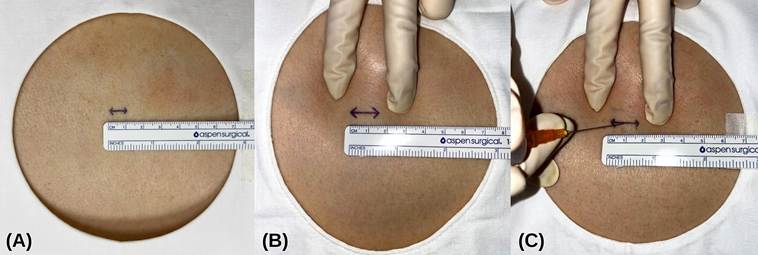
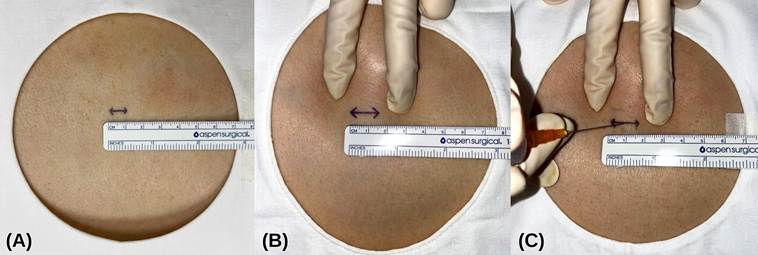
In the skin traction condition, the skin was displaced laterally immediately before needle insertion and maintained under tension throughout needle penetration (Figure 1). The operator stretched the skin around the needle entry point using the index and middle fingers and maintained tension during needle penetration. Under control conditions, infiltration was performed using an identical technique without skin manipulation. A standardized protocol based on relative elongation was implemented to ensure consistent application of manual skin traction. The maneuver was performed by a single experienced operator using a standardized protocol targeting approximately 50% skin elongation, as determined by visual and tactile assessment. This method was selected as a simple and clinically feasible approach to reduce variability in the application of traction. There were no important changes to the trial protocol after trial commencement.
Illustration of non-traction and manual skin traction techniques for local anesthetic injection. (A) Baseline skin marking without traction, with a reference distance of 1 cm between two points. (B) Manual skin traction applied to achieve 50% skin elongation (1.5 cm between reference points). (C) Local anesthetic infiltration performed during maintained skin traction. Arrows indicate the direction and extent of skin displacement.
Outcomes
The primary outcome was immediate injection pain intensity, measured using an 11-point NRS (0-10). Participants were asked to report their pain intensity immediately after needle insertion, and the post-insertion NRS score was predefined as the primary endpoint.
Secondary outcomes included injection-related unpleasantness, behavioral pain response, postprocedural injection-site soreness, and adverse events. Injection-related unpleasantness was assessed immediately after needle insertion using an 11-point NRS (0-10). Behavioral pain response was evaluated immediately after injection using the Pain Assessment in Advanced Dementia (PAINAD) scale (score range 0-10) [20], with assessments performed by a blinded evaluator. Although originally developed for patients with advanced dementia, the PAINAD has shown concurrent validity with self-reported pain in hospitalized older adults after hip fracture surgery, in a sample that included both cognitively impaired and intact patients [21], and in geriatric inpatients [22]. A previous study evaluating pain during local anesthetic injection in adult cancer patients also used a behavioral pain score based on the same five items as the PAINAD [23]. Although these studies do not establish the validity of the PAINAD for assessing brief procedural pain in cognitively intact outpatients, the PAINAD was included in the present study as a secondary observer-rated measure because it allowed behavioral pain responses to be assessed independently of participant self-report by an evaluator blinded to side allocation. Injection-site soreness and procedure-related adverse events were assessed at the second visit (approximately 4 weeks post-procedure). Harms were defined as any procedure-related adverse event, including local complications such as hematoma or infection, and were assessed by direct patient inquiry and clinical examination at the 4-week follow-up visit.
Patient demographics and clinical characteristics
Baseline demographic and clinical characteristics were collected during the first visit before randomization. The recorded variables included age, sex, body mass index (BMI), history of lumbar spine surgery, and comorbidities (hypertension, diabetes mellitus, and cancer).
Pain-related characteristics included pain duration (in months) and baseline pain intensity measured using an 11-point NRS (0-10). Because the primary outcome was immediate pain during local anesthetic infiltration rather than the severity of underlying radicular symptoms, baseline pain characteristics were assessed at the participant level rather than separately for each side. Current analgesic use was categorized as acetaminophen, non-steroidal anti-inflammatory drugs (NSAIDs), muscle relaxants, opioids/tramadol, anticonvulsants, and antidepressants.
Statistical analysis
The sample size was calculated for paired comparisons based on primary endpoints. Assuming a small effect size (Cohen's d = 0.3), α = 0.05, and 80% power, 94 participants were required. The final target sample size was set at 104 participants to account for an anticipated attrition rate of 10%. Continuous variables are presented as mean ± standard deviation (SD) or median (interquartile range [IQR]), as appropriate, and categorical variables as numbers (%).
Given the within-patient design, paired analyses were performed. The primary endpoint and secondary continuous outcomes were compared using the Wilcoxon signed-rank test, and paired categorical outcomes were analyzed using McNemar's test. To explore whether the treatment effect differed according to injection order, post hoc analyses were performed by calculating within-participant differences between the non-traction and traction conditions (non-traction minus traction) for immediate injection pain, unpleasantness, and behavioral pain scores. These differences were compared between participants who received traction on the right (first-injected) side and those who received traction on the left (second-injected) side using the Mann-Whitney U test.
Statistical significance was set at P < 0.05. The primary analysis was conducted on the full analysis set, defined as all randomized participants with available immediate outcome data. Follow-up outcomes were analyzed among participants who completed the 4-week assessment period. Statistical analyses were performed using IBM SPSS Statistics for Windows, version 29.0 (IBM Corp., Armonk, NY, USA).
Results
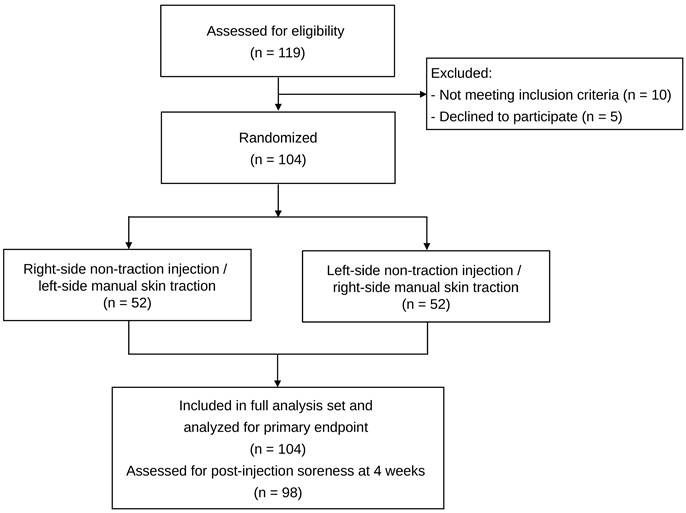
Between May and December 2025, 119 patients were assessed for eligibility. A total of 10 patients who did not meet the inclusion criteria and 5 who declined participation were excluded, resulting in 104 patients who were enrolled and randomized. All randomized participants were included in the full analysis set and analyzed for the primary endpoint (n = 104). Post-injection soreness at 4 weeks was assessed in 98 patients, as the remaining 6 patients did not attend the scheduled outpatient follow-up visit (Figure 2).
Study flowchart.
Baseline demographic and clinical characteristics are summarized in Table 1. The mean age was 71.00 ± 9.41 years, and 67 participants (64.4%) were female. The mean body mass index was 24.57 ± 3.62 kg/m². Hypertension was present in 54 participants (51.9%), diabetes mellitus in 22 (21.2%), and cancer in 15 (14.4%). Thirty participants (28.8%) had a history of spinal surgery.
Baseline characteristics of patients
| Variables | n = 104 |
|---|---|
| Patient characteristics | |
| Age, years | 71.00 ± 9.41 (31-87) |
| Sex, M/F | 37 (35.6)/67 (64.4) |
| BMI, kg/m2 | 24.57 ± 3.62 (16.02-36.75) |
| Comorbid medical disease, n (%) | |
| Hypertension | 54 (51.9) |
| Diabetes mellitus | 22 (21.2) |
| Cancer | 15 (14.4) |
| Spine surgery history, n (%) | 30 (28.8) |
| Pain-related data | |
| Pain duration, months | 36.00 (12-120) |
| Baseline pain score, NRS 0-10 | 5.24 ± 1.30 (3-9) |
| Previous medications, n (%) | |
| Acetaminophen | 16 (15.4) |
| NSAIDs | 40 (38.5) |
| Muscle relaxant | 19 (18.3) |
| Opioid/tramadol | 16 (15.4) |
| Anticonvulsant | 51 (49.0) |
| Antidepressant | 3 (2.9) |
Abbreviations: BMI: body mass index; NRS: numerical rating scale; NSAIDs: non-steroidal anti-inflammatory drugs.
Note: Values are presented as mean ± standard deviation (SD, range), median (interquartile range) or number of patients (%).
The median pain duration was 36 months (IQR, 12-120), and the mean baseline pain score was 5.24 ± 1.30 (range, 3-9). Frequently used medications included anticonvulsants (49.0%), NSAIDs (38.5%), muscle relaxants (18.3%), acetaminophen (15.4%), opioids/tramadol (15.4%), and antidepressants (2.9%).
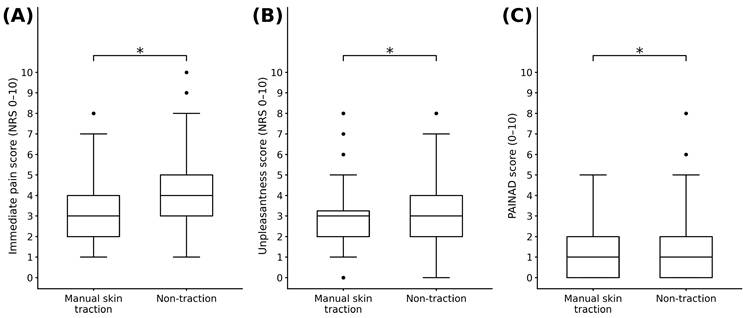
Immediate injection pain intensity was significantly lower under the skin traction condition than the non-traction condition (median [IQR], 3 [2-4] vs. 4 [3-5]; P < 0.001) (Figure 3). Injection-related unpleasantness (median [IQR], 3 [2-3.75] vs. 3 [2-4]; P = 0.003) and behavioral pain scores (median [IQR], 1 [0-2] vs. 1 [0-2]; P = 0.003) also differed significantly between conditions. In paired comparisons, lower pain scores were observed with skin traction in 43 participants, identical pain scores in 45 participants, and higher pain scores in 16 participants, consistent with the Wilcoxon signed-rank test.
Pain-related outcomes following manual skin traction and non-traction local anesthetic injection. (A) Immediate injection pain, (B) injection-related unpleasantness, and (C) behavioral pain score rated by a blinded observer using the Pain Assessment in Advanced Dementia (PAINAD) scale (0-10). Boxes represent the interquartile range, horizontal lines within boxes indicate the median, whiskers extend to the most extreme values within 1.5 times the interquartile range, and dots indicate outliers. *P < 0.05, Wilcoxon signed-rank test of paired differences.
In post hoc analyses, the within-participant treatment effects did not significantly differ according to whether traction was applied during the first (right-sided) or second (left-sided) injection. The median between-condition difference in immediate injection pain was 0 (IQR, 0-2) in both allocation groups (U = 1295.5, P = 0.700). Similarly, the median differences were 0 (IQR, 0-0) for unpleasantness (U = 1283.5, P = 0.489) and 0 (IQR, 0-1) for behavioral pain scores (U = 1342.0, P = 0.946) in both allocation groups.
At the 4-week follow-up (n = 98), transient injection-site soreness occurred in seven participants (7.1%) under the skin traction condition and nine (9.2%) under the non-traction condition, with no significant difference between the conditions (P = 0.500) (Table 2). No serious adverse events were observed.
Comparison of transient post-injection soreness within 4 weeks between manual skin traction and non-traction injections
| Variables | Manual skin traction (n = 98) | Non-traction injection (n = 98) | P-value |
|---|---|---|---|
| Post-procedural soreness within 4 weeks | 7 (7.1) | 9 (9.2) | 0.500 |
Note: Values are presented as number of participants (%). The manual skin traction and non-traction conditions represent paired sides within the same 98 participants. P-value was obtained using the exact McNemar test.
Discussion
In this randomized within-patient study, manual skin traction during local anesthetic infiltration significantly reduced immediate injection pain compared with the non-traction condition. Consistent with this finding, injection-related unpleasantness and behavioral pain scores also favored skin traction. Importantly, the technique was not associated with increased procedure-related complications, as transient injection-site soreness at 4 weeks was infrequent and comparable between conditions, and no serious adverse events were observed.
Spine-related interventional procedures are commonly performed in routine pain practice, often with local anesthetic infiltration before needle advancement [15]. However, the injection itself may cause discomfort and is often reported as the most unpleasant component of minor procedures [2]. Because injection-related pain can influence patient experience, procedural tolerance, and willingness to undergo repeat interventions, strategies to minimize this discomfort are clinically relevant [1-5]. A previous study has questioned the value of skin wheal anesthesia before spinal injections [24]. However, these findings were derived from lumbar medial branch block procedures, in which the local anesthetic and procedural needles were of the same caliber (25-gauge). In contrast, lumbar TFESI in the present study was performed using a substantially larger 22-gauge spinal needle following skin infiltration with a finer 25-gauge needle. Therefore, these findings may not be directly applicable to TFESI. The objective of the present study was not to evaluate the necessity of local anesthetic infiltration itself, but rather to reduce the discomfort associated with this routinely performed step.
Various strategies have been proposed to reduce injection-related pain, including modification of anesthetic solutions, topical anesthetics, altered injection techniques, smaller needle sizes, slower injection rates, cooling, and vibrotactile counterstimulation [1,2,5,25]. Recent reviews of non-pharmacological interventions for needle-related pain have reached similar conclusions, while noting that the supporting evidence remains heterogeneous [7,8]. Several studies have shown that cooling and vibration techniques can effectively reduce pain during needle procedures [26-28]. However, some of these approaches require additional equipment or preparation time [2,25].
Manual skin traction is a simple, cost-free maneuver that can be incorporated directly into routine injection techniques without specialized equipment or modification of anesthetic solutions. Because it relies solely on manual skin traction, sterility is preserved, and the procedural burden is minimal. Such low-cost, easily adoptable refinements may be particularly valuable in routine procedural practice [2]. The present findings support the feasibility of this approach by demonstrating reduced immediate injection pain without increased delayed soreness.
The analgesic effects of skin traction may be mediated by both neurophysiological and mechanical mechanisms. Neurophysiologically, concurrent cutaneous stimulation produced by skin traction may activate low-threshold mechanoreceptive afferents, attenuating nociceptive input during needle penetration, consistent with the gate control theory of pain [9]. This interpretation aligns with prior studies showing that vibrotactile or other sensory stimulation can reduce pain during local anesthetic injections and related needle procedures [10,27]. In addition, skin traction may influence the local tissue mechanics at the injection site. By pre-tensioning the skin and superficial soft tissues before needle entry, manual skin traction may modify the needle-tissue interaction and reduce the discomfort associated with tissue deformation during penetration. Consistent with this possibility, physical stimulation techniques, including manual pressure and a combined technique incorporating skin traction, have been reported to reduce pain during intramuscular injections, although the certainty of this evidence remains limited [13,14]. Collectively, these mechanisms provide a plausible explanation for reduced injection pain associated with skin traction.
When examined at the individual level, paired comparisons showed a directional predominance favoring skin traction. In randomized within-patient designs, treatment effects are evaluated by comparing outcomes within the same participant, thereby minimizing between-person variability and increasing sensitivity to detect intervention effects [18]. Although immediate injection pain was significantly lower with skin traction, the magnitude of the difference was modest, with a median difference of 1 point on the 11-point NRS, and nearly half of the participants reported identical pain scores. Recent estimates of the minimal clinically important difference (MCID) for acute postsurgical pain have ranged from approximately 1.2 to 1.6 points on an 11-point pain scale [29]. However, MCID estimates are context dependent, and their applicability across different acute pain settings remains uncertain [30]. In particular, these estimates were derived from changes in postoperative pain rather than pain evoked by a brief procedural stimulus. Accordingly, the present findings should be interpreted as demonstrating a modest reduction in immediate procedural pain rather than a uniformly clinically meaningful benefit.
This study has several strengths. The randomized within-patient design allowed direct comparison of the two techniques in the same participant, minimizing interindividual variability in pain perception. Additionally, the intervention was evaluated during routine clinical procedures, supporting the real-world applicability of the findings.
This study has several limitations. First, neither the proceduralists nor the participants could be blinded because manual skin traction is readily perceptible. Thus, expectation or anticipatory effects may have influenced pain ratings, and participants' perceptions of treatment allocation and expectations were not formally assessed. In addition, the fixed right-first injection sequence may have introduced an order effect, although post hoc analysis showed no significant difference in treatment effects according to injection order. Second, this was a single-center study involving predominantly older adults, with all procedures performed by a single operator, which may limit the generalizability. Third, although the immediate injection pain, unpleasantness, and behavioral pain scores favored skin traction, the absolute between-condition differences were modest. Fourth, traction was standardized by relative skin elongation rather than objectively measured force. Variations in skin elasticity, particularly in older adults, may therefore have resulted in nonuniform mechanical tension and sensory stimulation, limiting reproducibility. Finally, no physiological or sensory measurements were performed to clarify the mechanisms underlying the observed effects. Because the control condition did not include matched tactile stimulation, the contribution of nonspecific tactile input to the observed pain reduction cannot be excluded.
Conclusions
Manual skin traction during local anesthetic infiltration significantly reduced immediate injection pain. Injection-related unpleasantness and behavioral pain responses showed similar directional improvements without increasing delayed soreness or procedure-related adverse events. Given its simplicity, cost-free nature, and ease of implementation, skin traction may represent a practical adjunct for improving patient comfort during interventional procedures.
Abbreviations
TFESI: transforaminal epidural steroid injection; NRS: numerical rating scale; PAINAD: Pain Assessment in Advanced Dementia; BMI: body mass index; SD: standard deviation; IQR: interquartile range; NSAIDs: non-steroidal anti-inflammatory drugs.
Acknowledgements
The authors thank Sang Jun Park, MD, Ju Chan Song, BSN, and Seoung Chan Jo, BSN, for their assistance in this study.
Funding
This study was supported by a Severance Hospital Research fund for Clinical excellence (SHRC) (C-2026-0006).
Data availability
The data supporting the findings of this study are available from the corresponding author (Hee Jung Kim, heejkim@yuhs.ac) upon reasonable request.
Authorship statement
JYK: literature review, data collection, data analysis, manuscript writing, and manuscript editing; SHK: literature review and manuscript editing; KBY: conceptualization and study design; DHK: data collection and manuscript editing; HJK: conceptualization, study design, data analysis, manuscript writing, and manuscript editing. All authors approved the final manuscript.
Competing Interests
All authors have no conflict of interest.
References
1. St Clair-Jones A, Prignano F, Goncalves J, Paul M, Sewerin P. Understanding and minimising injection-site pain following subcutaneous administration of biologics: a narrative review. Rheumatol Ther. 2020;7:741-757
2. Strazar AR, Leynes PG, Lalonde DH. Minimizing the pain of local anesthesia injection. Plast Reconstr Surg. 2013;132:675-684
3. Cho SY, Kim E, Park SH, Roh BD, Lee CY, Lee SJ. et al. Effect of topical anesthesia on pain from needle insertion and injection and its relationship with anxiety in patients awaiting apical surgery: a randomized double-blind clinical trial. J Endod. 2017;43:364-369
4. Charalambides M, Yannoulias B, Gnanappiragasam D, Veitch D, Wernham A. Local anaesthetics in dermatological surgery: a review of adjuncts and pain reduction techniques. Clin Exp Dermatol. 2022;47:1781-1793
5. Hogan ME, Kikuta A, Taddio A. A systematic review of measures for reducing injection pain during adult immunization. Vaccine. 2010;28:1514-1521
6. Boerner KE, Birnie KA, Chambers CT, Taddio A, McMurtry CM, Noel M. et al. Simple psychological interventions for reducing pain from common needle procedures in adults: systematic review of randomized and quasi-randomized controlled trials. Clin J Pain. 2015;31:S90-S98
7. Romańczuk D, Maruszak A, Lange S, Mędrzycka-Dąbrowska W, Cichowlas G, Gąsior A. Nonpharmacological interventions for pain relief during peripheral venous cannulation: implications for practice. J Clin Med. 2026;15:2662
8. Sharifnia AM, Chu G, Manias E, Davidson PM, Fernandez R. Comparative analysis of the effectiveness of pharmacological and non-pharmacological interventions on arteriovenous fistula cannulation-related pain in patients receiving hemodialysis: a systematic review and network meta-analysis. Int J Nurs Stud. 2025;169:105123
9. Melzack R, Wall PD. Pain mechanisms: a new theory. Science. 1965;150:971-979
10. Mortada H, Al Qurashi AA, Alnaim MF, Arab K, Kattan AE. Effectiveness of using a vibration device to ease pain during upper extremity injections: a randomized controlled trial. Saudi J Anaesth. 2024;18:488-495
11. Chai B, Gao L, Song Y, Wang Y, Pan X, Le W. et al. The effect of local skin precooling on alleviating injection site pain in patients with androgenetic alopecia receiving a scalp nerve block. Pain Physician. 2025;28:155-165
12. Larouche MC, Camiré Bernier S, Racine R, Collin O, Desmons M, Mailloux C. et al. Stretch-induced hypoalgesia: a pilot study. Scand J Pain. 2020;20:837-845
13. CMC S, Lord H, Vargese SS, Kurian N, Cherian SA, Mathew E. et al. Effectiveness of physical stimulation for reducing injection pain in adults receiving intramuscular injections: a systematic review and meta-analysis. JBI Evid Synth. 2023;21:373-400
14. Salari M, Estaji Z, Akrami R, Rad M. Comparison of skin traction, pressure, and rapid muscle release with conventional method on intramuscular injection pain: a randomized clinical trial. J Educ Health Promot. 2018;7:172
15. Smuek A, Bakshi R, Mays R, Huynh L, Levin J, Rittenberg J. et al. “Is this injection going to hurt?” Quantifying the pain experience during common lumbosacral spine injections. Interv Pain Med. 2025;4:100632
16. Pandis N, Chung B, Scherer RW, Elbourne D, Altman DG. CONSORT 2010 statement: extension checklist for reporting within-person randomised trials. BMJ. 2017;357:j2835
17. Fillingim RB. Individual differences in pain: understanding the mosaic that makes pain personal. Pain. 2017;158(Suppl 1):S11-S18
18. Lehr AM, Jacobs WCH, Stellato RK, Castelein RM, Oner FC, Kruyt MC. Methodological aspects of a randomized within-patient concurrent controlled design for clinical trials in spine surgery. Clin Trials. 2022;19:259-266
19. Riba-Roca A, Figueiredo R, Malamed SF, Arnabat-Dominguez J. A randomized split-mouth clinical trial comparing pain experienced during palatal injections with two different computer-controlled local anesthetic delivery systems. J Clin Exp Dent. 2020;12:e1139-e1144
20. Warden V, Hurley AC, Volicer L. Development and psychometric evaluation of the Pain Assessment in Advanced Dementia (PAINAD) scale. J Am Med Dir Assoc. 2003;4:9-15
21. DeWaters T, Faut-Callahan M, McCann JJ, Paice JA, Fogg L, Hollinger-Smith L. et al. Comparison of self-reported pain and the PAINAD scale in hospitalized cognitively impaired and intact older adults after hip fracture surgery. Orthop Nurs. 2008;27:21-28
22. Mosele M, Inelmen EM, Toffanello ED, Girardi A, Coin A, Sergi G. et al. Psychometric properties of the pain assessment in advanced dementia scale compared to self assessment of pain in elderly patients. Dement Geriatr Cogn Disord. 2012;34:38-43
23. Kim SH, Yoon DM, Choi KW, Yoon KB. High-dose daily opioid administration and poor functional status intensify local anesthetic injection pain in cancer patients. Pain Physician. 2013;16:E247-E256
24. Chen AS, Miccio VF Jr, Smith CC, Christolias GC, Blanchard AR. Procedural pain during lumbar medial branch blocks with and without skin wheal anesthesia: a prospective comparative observational study. Pain Med. 2019;20:779-783
25. Gostimir M, Hussain A. A systematic review and meta-analysis of methods for reducing local anesthetic injection pain among patients undergoing periocular surgery. Ophthalmic Plast Reconstr Surg. 2019;35:113-125
26. Her J, Kim KY, Lee YJ, Kim BS, Hur MH. The effects of thermotherapy and cryotherapy on pain and fear during intravenous cannulation: a systematic review and meta-analysis. J Korean Biol Nurs Sci. 2025;27:295-316
27. Yilmaz D, Guney BG. Effect of vibration on pain during subcutaneous heparin injection: a randomized, single-blind, placebo-controlled trial. Open Med (Wars). 2025;20:20251272
28. Pedersen JB, Martensen A, Funder P, Bakke SA, Bhavsar RP, Strom T. Cryospray reduces pain during venous cannulation in elective surgery patients: a randomized placebo-controlled study. BMC Anesthesiol. 2024;24:466
29. Vollert J, Egert VM, Segelcke D, Fletcher D, Kalso E, Kemp H. et al. Minimal clinically important changes of patient-reported outcome measures for acute postsurgical pain. Anesthesiology. 2026;144:143-153
30. Muñoz-Leyva F, El-Boghdadly K, Chan V. Is the minimal clinically important difference (MCID) in acute pain a good measure of analgesic efficacy in regional anesthesia? Reg Anesth Pain Med. 2020;45:1000-1005
Author contact
Corresponding author: Hee Jung Kim, MD, PhD. Tel: 82-2-2228-7500 Fax: 82-2-364-2951 E-mail: heejkimac ORCID: 0000-0002-2143-3943.