Impact Factor ISSN: 1449-1907




Int J Med Sci 2026; 23(10):3220-3227. doi:10.7150/ijms.139320 This issue Cite
Research Paper
Association of Preoperative Pan-Immune-Inflammation Value with Adverse Pathology and Oncological Outcomes Following Radical Prostatectomy: A Single-Center Retrospective Study
Tsz-Yi Tang, MD1,2,3, Hao-Han Chang, MD2, Yung-Shun Juan, MD, PhD3, Yung-Chin Lee, MD, PhD2, Chia-Yang Lee, PhD1, Jiun-Hung Geng, MD, PhD1,2  , Shu-Pin Huang, MD, PhD1,3,4
1. Graduate Institute of Clinical Medicine, College of Medicine, Kaohsiung Medical University, Kaohsiung, Taiwan.
2. Department of Urology, Kaohsiung Municipal Siaogang Hospital, Kaohsiung Medical University, Kaohsiung, Taiwan.
3. Department of Urology, Kaohsiung Medical University Hospital, Kaohsiung Medical University, Kaohsiung, Taiwan.
4. Department of Urology, School of Medicine, College of Medicine, Kaohsiung Medical University, Kaohsiung, Taiwan.
Received 2026-6-14; Accepted 2026-8-19; Published 2026-9-3
Abstract
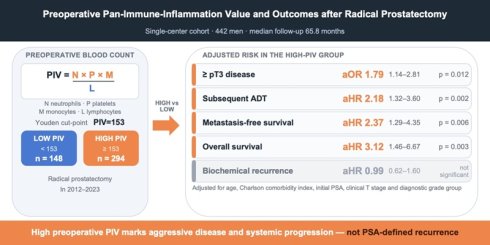
Background: High Pan-Immune-Inflammation Value (PIV) has been associated with poorer survival outcomes in men with metastatic prostate cancer. However, whether PIV is associated with adverse pathology and long-term oncological outcomes in localized prostate cancer treated with radical prostatectomy (RP) remains unclear.
Methods: We retrospectively evaluated 808 men who underwent RP for prostate adenocarcinoma at Kaohsiung Medical University Hospital between 2012 and 2023; 442 met the eligibility criteria and were included in the final analysis. PIV was dichotomized using a Youden-derived cutpoint (153) based on subsequent androgen deprivation therapy (ADT), defined as any adjuvant or salvage ADT administered after RP. We used multivariable logistic and Cox regression models to evaluate associations between preoperative PIV and adverse pathological features, subsequent ADT, biochemical recurrence (BCR), metastasis-free survival (MFS), and overall survival (OS).
Results: Median follow-up was 65.8 months. During follow-up, 100 men (22.6%) received subsequent ADT, 71 (16.1%) developed metastasis or died, and 54 (12.2%) died. High PIV was independently associated with ≥pT3 disease (adjusted odds ratio [aOR] 1.79, 95% confidence interval [CI] 1.14-2.81; p = 0.012), subsequent ADT (adjusted hazard ratio [aHR] 2.18, 95% CI 1.32-3.60; p = 0.002), shorter MFS (aHR 2.37, 95% CI 1.29-4.35; p = 0.006), and shorter OS (aHR 3.12, 95% CI 1.46-6.67; p = 0.003), but not with BCR.
Conclusions: High preoperative PIV was independently associated with ≥pT3 disease, subsequent ADT, shorter MFS, and shorter OS after RP, but not with BCR. These findings suggest that PIV may reflect disease progression beyond PSA-defined recurrence and may serve as a complementary preoperative biomarker. Further validation in independent cohorts is required.
Keywords: prostate cancer, radical prostatectomy, pan-immune-inflammation value, systemic inflammation, androgen deprivation therapy, overall survival
Introduction
Prostate cancer is the second most commonly diagnosed malignancy in men worldwide, and its global burden continues to grow [1, 2]. However, despite curative intent, approximately 20-50% of patients develop biochemical recurrence within 10 years after treatment, and a subset subsequently progresses to metastatic disease [3]. Preoperative risk stratification still relies mainly on the serum prostate-specific antigen (PSA), biopsy Gleason grade group, clinical stage, and multiparametric magnetic resonance imaging [4, 5]. However, predicting postoperative outcomes remains challenging, highlighting the need for simple and readily available biomarkers to improve preoperative risk assessment.
Systemic inflammation is increasingly recognized as a hallmark of cancer. It contributes to tumor progression, invasion, and metastatic dissemination [6, 7], and platelets interact directly with tumor cells to facilitate spread [8]. The pan-immune-inflammation value (PIV), derived from the neutrophil, platelet, monocyte, and lymphocyte counts of a routine blood test, integrates these immune compartments into a single index. It was originally developed in metastatic colorectal cancer, where it demonstrated stronger prognostic performance than conventional inflammation-based biomarkers and was independently associated with survival outcomes [9]. Similar associations have been reported in other malignancies, including breast cancer, lung cancer, and esophageal cancer, where elevated PIV has been linked to poorer treatment response and survival [10, 11]. In prostate cancer, a higher PIV has been associated with shorter overall survival (OS) in metastatic castration-resistant disease [12] and with the presence of malignancy at biopsy in men with a PSA level of 4-20 ng/mL [13]. Because PIV reflects the systemic inflammatory burden generated by a tumor, it may also mirror the aggressiveness of localized disease before surgery. Other blood-based inflammation indices also have been linked to adverse pathology, biochemical recurrence, and survival after RP [14-17], consistent with their prognostic value across solid tumors [18, 19].
Evidence regarding the association between preoperative PIV and postoperative treatment requirements and long-term oncological outcomes after curative surgery remains limited. This gap is clinically important because biochemical recurrence, defined by PSA alone, is heterogeneous and does not reliably predict metastasis or mortality [20, 21]. In contrast, the need for postoperative systemic therapy may better reflect disease progression. Whether preoperative PIV can identify men who will require postoperative systemic therapy remains unknown.
Thus, we aimed to evaluate the association of preoperative PIV with adverse pathological features after radical prostatectomy and with postoperative outcomes, including subsequent androgen deprivation therapy (ADT), metastasis-free survival (MFS), OS, and biochemical recurrence (BCR). The lymphocyte-to-monocyte ratio (LMR) was reported as a biologically opposing comparator.
Materials and Methods
Study cohort
We retrospectively reviewed consecutive men who underwent radical prostatectomy (RP) for prostate cancer at Kaohsiung Medical University Hospital (KMUH) between 2012 and 2023. Of 811 patients identified, three with non-prostate cancer pathology were excluded, leaving 808 men for analysis. We obtained clinical and pathological characteristics, preoperative laboratory data, PSA measurements, and treatment details from electronic medical records and the institutional cancer registry. The study was conducted in accordance with the Declaration of Helsinki and approved by the Institutional Review Board of Kaohsiung Medical University Hospital (KMUHIRB-E(I)-20260221). Informed consent was not required because of the retrospective study design.
Preoperative PIV assessment
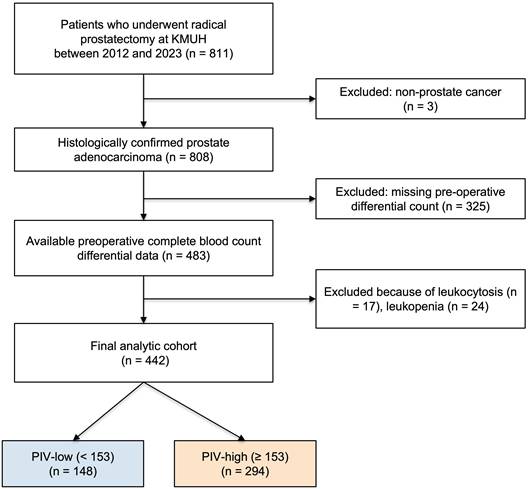
A complete preoperative differential count was available in 483 men. We excluded 41 men with confounding counts (leukocytosis, > 11 × 10³/µL; leukopenia, < 4 × 10³/µL), leaving 442 men in the final analytical cohort (Figure 1). PIV was calculated as neutrophils × platelets × monocytes/ lymphocytes. We identified the preoperative PIV cutpoint (153) using the Youden index for subsequent ADT, and divided the population into low- and high-PIV groups. Preoperative PIV was right-skewed (median 196.7, IQR 131.4-323.1, range 23.8-2674.7; skewness 4.4); LMR (lymphocytes/monocytes) was summarized descriptively as a comparator. The distribution of PIV and LMR is shown in Supplementary Figure S1.
Study flow diagram of patient selection and stratification into low- and high-PIV groups.
Outcomes
Subsequent ADT was defined as any adjuvant or salvage ADT initiated after radical prostatectomy and was considered a treatment-decision outcome reflecting real-world postoperative management. Grade-group upgrading was defined as a higher pathological grade group in the radical prostatectomy specimen than at biopsy. BCR was defined as two consecutive PSA measurements ≥ 0.2 ng/mL following an initially undetectable postoperative PSA level. BCR was evaluable in 321 of the 442 men; the remaining 121 were excluded from BCR analyses because their postoperative PSA data were insufficient to determine BCR status (no documented undetectable postoperative PSA nadir, or fewer than two postoperative PSA measurements). MFS was defined as the time from radical prostatectomy to radiographic metastasis or death from any cause, whichever occurred first [22]. OS was defined as the time from radical prostatectomy to death from any cause. We calculated time-to-event outcomes from the date of radical prostatectomy to the occurrence of the respective endpoint or last follow-up. For the subsequent ADT analysis, we measured time from the date of radical prostatectomy to the initiation of adjuvant or salvage ADT. We excluded 26 men because the postoperative interval to subsequent ADT could not be defined, leaving 416 men for analysis. Metastasis-free survival and overall survival were both measured from the date of radical prostatectomy and therefore included all 442 men.
Statistical analysis
Descriptive analyses used absolute frequencies and percentages for categorical variables and medians with interquartile ranges (IQRs) for continuous variables. Categorical variables were compared using the χ² test or Fisher's exact test, as appropriate, and continuous variables using the Mann-Whitney U test. The preoperative PIV and LMR cutpoints were identified using the Youden index from receiver-operating characteristic (ROC) analysis for subsequent ADT. Associations between PIV and adverse pathological outcomes (≥pT3 disease, pathological grade group ≥ 4, lymph-node metastasis, grade-group upgrading, and positive surgical margin [PSM]) were evaluated using multivariable logistic regression models adjusted for age, diagnostic grade group, initial PSA (per ng/mL) and clinical T stage, with results reported as odds ratios (ORs) and 95% confidence intervals (CIs). We used the Kaplan-Meier method to estimate survival curves for subsequent ADT, MFS, and OS, and compared them using the log-rank test. Univariable and multivariable Cox proportional-hazards regression models were used to evaluate associations between PIV and time-to-event outcomes, reporting results as adjusted hazard ratios (aHRs) and 95% CIs. Covariates included in multivariable models were selected a priori based on established clinical relevance and previous prostate cancer prognostic models. Multivariable models for subsequent ADT, MFS, and OS were adjusted for the same pre-specified preoperative covariates: age, Charlson comorbidity index, log-transformed initial PSA, clinical T stage, and diagnostic grade group. Continuous covariates were modeled per unit, whereas PIV was analyzed as a dichotomous variable using the Youden-derived cutpoint. The proportional-hazards assumption was assessed using Schoenfeld residuals; no violation was detected (global p = 0.17, 0.31, and 0.11 for subsequent ADT, MFS, and OS, respectively). Because PIV was primarily analyzed using a data-derived dichotomous cutpoint, we further explored the association between PIV and the risk of subsequent ADT using a univariable restricted cubic spline model to assess the shape and potential non-linearity of the dose-response relationship. The spline model used three knots placed at the 10th, 50th, and 90th percentiles of the log-transformed PIV distribution and was truncated at the 95th percentile. In addition, we performed sensitivity analyses using PIV tertiles to evaluate whether the observed associations were robust to alternative PIV categorizations. All statistical analyses were conducted using SAS version 9.4 and R version 4.5.2. Statistical significance was defined as a two-sided p-value of < 0.05. The authors used Claude (Anthropic) to assist with language editing and structural revision of the manuscript.
Results
Patients
Among 811 men who underwent radical prostatectomy, 808 had prostate adenocarcinoma, and preoperative differential blood counts were available for 483. After excluding 17 men with leukocytosis and 24 with leukopenia, 442 remained in the analytical cohort: 148 with low PIV and 294 with high PIV (Figure 1). The median follow-up was 65.8 months.
Table 1 shows baseline characteristics. Men with high PIV were more likely to have ≥ pT3 disease (51.7% vs 37.2%, p = 0.004) and to receive subsequent ADT (27.2% vs 13.5%, p = 0.001). They also experienced more MFS events, defined as metastasis or death from any cause (19.7% vs 8.8%, p = 0.003), and higher all-cause mortality (15.6% vs 5.4%, p = 0.002). As expected, LMR was lower in the high-PIV group (median 3.5 vs 5.5, p < 0.001). Overall, 100 men (22.6%) received subsequent ADT and 54 (12.2%) died. Postoperative radiotherapy was administered to 70 men (15.8%) and did not differ between the high- and low-PIV groups (14.6% vs 18.2%, p = 0.326).
Baseline clinicopathological characteristics stratified by PIV status in patients who underwent radical prostatectomy.
| Characteristic | Total (n = 442) | Low PIV (n = 148) | High PIV (n = 294) | p |
|---|---|---|---|---|
| Age, years | 69.0 (64.9-72.8) | 68.8 (64.8-72.1) | 69.0 (65.1-73.2) | 0.364 |
| Charlson comorbidity index | 0.218 | |||
| 0 | 142 (32.1) | 41 (27.7) | 101 (34.4) | |
| 1-2 | 182 (41.2) | 69 (46.6) | 113 (38.4) | |
| ≥ 3 | 118 (26.7) | 38 (25.7) | 80 (27.2) | |
| Hypertension | 257 (58.1) | 82 (55.4) | 175 (59.5) | 0.407 |
| Diabetes mellitus | 114 (25.8) | 32 (21.6) | 82 (27.9) | 0.155 |
| Coronary artery disease | 74 (16.7) | 24 (16.2) | 50 (17.0) | 0.834 |
| ECOG performance status | 0.155 | |||
| 0 | 49 (11.1) | 21 (14.2) | 28 (9.5) | |
| 1 | 373 (84.4) | 116 (78.4) | 257 (87.4) | |
| ≥ 2 | 1 (0.2) | 0 (0.0) | 1 (0.3) | |
| Unknown | 19 (4.3) | 11 (7.4) | 8 (2.7) | |
| Initial PSA, ng/mL | 11.8 (7.2-23.2) | 11.4 (7.0-20.4) | 12.1 (7.3-25.5) | 0.417 |
| Clinical T stage | 0.344 | |||
| cT1 | 34 (7.7) | 14 (9.5) | 20 (6.8) | |
| cT2 | 319 (72.2) | 109 (73.6) | 210 (71.4) | |
| cT3-4 | 89 (20.1) | 25 (16.9) | 64 (21.8) | |
| Diagnostic grade group | 0.184 | |||
| 1 | 163 (36.9) | 57 (38.5) | 106 (36.1) | |
| 2 | 62 (14.0) | 26 (17.6) | 36 (12.2) | |
| 3 | 82 (18.6) | 30 (20.3) | 52 (17.7) | |
| 4 | 68 (15.4) | 19 (12.8) | 49 (16.7) | |
| 5 | 67 (15.2) | 16 (10.8) | 51 (17.3) | |
| Pathological ISUP grade group | 0.121 | |||
| 1 | 81 (18.3) | 30 (20.3) | 51 (17.3) | |
| 2 | 100 (22.6) | 40 (27.0) | 60 (20.4) | |
| 3 | 92 (20.8) | 29 (19.6) | 63 (21.4) | |
| 4 | 61 (13.8) | 23 (15.5) | 38 (12.9) | |
| 5 | 108 (24.4) | 26 (17.6) | 82 (27.9) | |
| Grade-group upgrading | 190 (43.0) | 60 (40.5) | 130 (44.2) | 0.424 |
| Pathological stage ≥pT3 | 207 (46.8) | 55 (37.2) | 152 (51.7) | 0.004 |
| Lymph-node metastasis (pN1) | 25 (7.8) | 8 (7.5) | 17 (7.9) | 0.919 |
| Not performed | 120 (27.1) | 42 (28.4) | 78 (26.5) | |
| PSM | 200 (45.2) | 65 (43.9) | 135 (45.9) | 0.690 |
| PIV | 196.7 (131.4-323.1) | 110.0 (87.2-131.4) | 264.2 (196.9-410.5) | < 0.001 |
| LMR | 4.1 (3.1-5.3) | 5.5 (4.5-6.6) | 3.5 (2.8-4.4) | < 0.001 |
| Outcomes | ||||
| Subsequent ADT | 100 (22.6) | 20 (13.5) | 80 (27.2) | 0.001 |
| Metastasis or death (MFS event) | 71 (16.1) | 13 (8.8) | 58 (19.7) | 0.003 |
| Death (OS event) | 54 (12.2) | 8 (5.4) | 46 (15.6) | 0.002 |
| Postoperative radiotherapy | 70 (15.8) | 27 (18.2) | 43 (14.6) | 0.326 |
| BCR | 79 (24.6) | 26 (23.4) | 53 (25.2) | 0.720 |
Data are median (interquartile range) for continuous variables and n (%) for categorical variables. PIV was divided at 153 (Youden index for subsequent ADT). The p value compares low versus high PIV (Mann-Whitney U, or χ² / Fisher exact test). BCR is presented among the 321 men in whom BCR status was evaluable (low PIV, n = 111; high PIV, n = 210). IQR: interquartile range; ECOG: Eastern Cooperative Oncology Group; PSA: prostate-specific antigen; cT: clinical tumor stage; ISUP: International Society of Urological Pathology; pT: pathological tumor stage; pN: pathological lymph-node stage; PSM: positive surgical margin; PIV: pan-immune-inflammation value; LMR: lymphocyte-to-monocyte ratio; ADT: androgen deprivation therapy; MFS: metastasis-free survival; OS: overall survival; BCR: biochemical recurrence.
PIV and adverse pathology
Supplementary Table S1 shows associations between preoperative PIV and adverse pathological outcomes. In multivariable logistic regression, high PIV was independently associated with ≥ pT3 disease (aOR 1.79, 95% CI 1.14-2.81, p = 0.012). No significant associations were observed for pathological grade group ≥ 4 disease (OR 1.29, 95% CI 0.79-2.13, p = 0.309), lymph-node metastasis (OR 0.87, 95% CI 0.35-2.16, p = 0.762), grade-group upgrading (OR 1.40, 95% CI 0.90-2.17, p = 0.136), or PSM (OR 0.99, 95% CI 0.66-1.49, p = 0.968).
PIV and clinical outcomes after RP
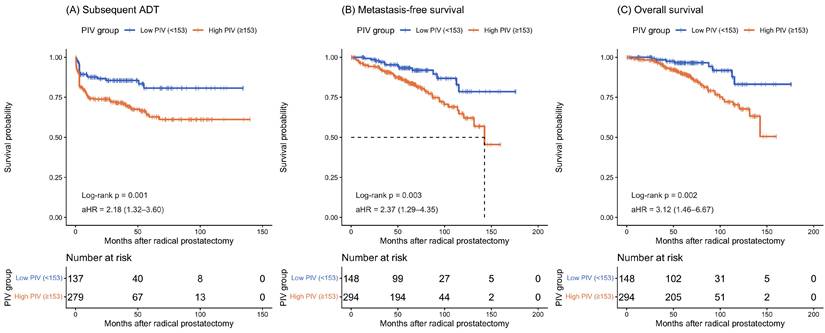
Men with high PIV were more likely to receive subsequent ADT than those with low PIV (log-rank p = 0.001; Figure 2A). In Cox regression analyses, high PIV was associated with a shorter time to subsequent ADT in both univariable (HR 2.22, 95% CI 1.36-3.63, p = 0.001) and multivariable models (aHR 2.18, 95% CI 1.32-3.60, p = 0.002; Table 2). MFS was also shorter in the high-PIV group (log-rank p = 0.003; Figure 2B), and the association persisted after adjustment (aHR 2.37, 95% CI 1.29-4.35, p = 0.006; Table 2). OS was also shorter (log-rank p = 0.002; Figure 2C), and high PIV was independently associated with all-cause mortality (aHR 3.12, 95% CI 1.46-6.67, p = 0.003; Table 2). In contrast, preoperative PIV was not associated with BCR (aHR 0.99, 95% CI 0.62-1.60, p = 0.98; n = 321).
Kaplan-Meier curves for (A) subsequent androgen deprivation therapy (ADT), (B) metastasis-free survival (MFS), and (C) overall survival (OS) according to preoperative pan-immune-inflammation value (PIV) group. Log-rank p values and adjusted hazard ratios (aHRs) are displayed in each panel. The ADT analysis included 416 men because a valid postoperative interval to subsequent ADT could not be defined in 26 patients.
Univariable and multivariable Cox regression models for subsequent androgen deprivation therapy, metastasis-free survival, and overall survival after radical prostatectomy.
| Characteristic | Subsequent ADT | MFS | OS | |||||||||
|---|---|---|---|---|---|---|---|---|---|---|---|---|
| Univariable | Multivariable | Univariable | Multivariable | Univariable | Multivariable | |||||||
| HR (95% CI) | p | HR (95% CI) | p | HR (95% CI) | p | HR (95% CI) | p | HR (95% CI) | p | HR (95% CI) | p | |
| PIV, high vs low (≥ 153 vs < 153) | 2.22 (1.36-3.63) | 0.001 | 2.18 (1.32-3.60) | 0.002 | 2.40 (1.32-4.39) | 0.004 | 2.37 (1.29-4.35) | 0.006 | 3.05 (1.43-6.46) | 0.004 | 3.12 (1.46-6.67) | 0.003 |
| Age, per year | 1.03 (1.00-1.07) | 0.037 | 1.02 (0.98-1.05) | 0.339 | 1.04 (1.00-1.08) | 0.041 | 1.03 (0.99-1.07) | 0.099 | 1.04 (1.00-1.09) | 0.074 | 1.04 (0.99-1.09) | 0.101 |
| Charlson comorbidity index, per point | 0.93 (0.83-1.04) | 0.190 | 0.94 (0.84-1.05) | 0.264 | 1.08 (0.97-1.19) | 0.156 | 1.12 (1.01-1.25) | 0.039 | 1.10 (0.98-1.23) | 0.111 | 1.14 (1.01-1.29) | 0.038 |
| Initial PSA, per log ng/mL | 1.72 (1.47-2.01) | < 0.001 | 1.56 (1.28-1.89) | < 0.001 | 1.24 (0.99-1.57) | 0.065 | 1.26 (0.98-1.61) | 0.073 | 1.04 (0.81-1.33) | 0.777 | 1.07 (0.81-1.41) | 0.621 |
| Clinical T stage, cT3-4 vs cT1-2 | 2.23 (1.48-3.36) | < 0.001 | 1.40 (0.91-2.18) | 0.129 | 1.23 (0.72-2.09) | 0.441 | 1.06 (0.60-1.85) | 0.845 | 0.77 (0.40-1.50) | 0.444 | 0.66 (0.33-1.34) | 0.252 |
| Diagnostic grade group, per unit | 1.49 (1.30-1.70) | < 0.001 | 1.29 (1.11-1.49) | < 0.001 | 1.08 (0.93-1.26) | 0.296 | 0.98 (0.83-1.16) | 0.802 | 1.07 (0.90-1.27) | 0.467 | 1.03 (0.85-1.25) | 0.757 |
Each multivariable model included all listed covariates simultaneously. Continuous covariates (age, Charlson comorbidity index, log-transformed initial PSA, diagnostic grade group) are expressed per unit; clinical T stage (cT3-4 vs cT1-2) and PIV (≥153 vs <153) are dichotomized. ADT: androgen deprivation therapy; CI: confidence interval; HR: hazard ratio; MFS: metastasis-free survival; OS: overall survival; PIV: pan-immune-inflammation value; PSA: prostate-specific antigen.
Spline and sensitivity analyses
The univariable (unadjusted) restricted cubic spline analysis demonstrated a positive association between preoperative PIV and the risk of subsequent ADT (overall p = 0.017), with no evidence of non-linearity (non-linear p = 0.169; Supplementary Figure S2). When PIV was categorized into tertiles, the risks of subsequent ADT, metastasis, or death increased progressively across tertiles (univariable Cox linear-trend p = 0.005, 0.003, and < 0.001, respectively; Supplementary Figure S3), supporting the robustness of the primary findings.
Discussion
In this single-center cohort of men undergoing radical prostatectomy for clinically localized prostate cancer, a higher preoperative PIV was independently associated with ≥ pT3 disease, subsequent ADT, shorter MFS, and shorter OS, but not with BCR. Patients with a high PIV had approximately 2-fold higher risks of subsequent ADT and of metastasis or death and a more than 3-fold higher risk of death compared with those with a low PIV.
Interestingly, there was no connection between preoperative PIV and BCR. BCR is defined solely by a rise in prostate-specific antigen (PSA) and represents a heterogeneous event that does not necessarily translate into metastatic progression or mortality. Consequently, BCR is only modestly associated with long-term survival outcomes and remains an imperfect surrogate for disease progression [3, 20]. Even persistent postoperative PSA captures only part of the prognostic picture [23, 24]. By contrast, MFS has been formally validated as a strong surrogate of OS in localized prostate cancer in a meta-analysis of nearly 29,000 men [22], and subsequent ADT generally reflects clinically significant disease progression. The differential association of PIV with these outcomes suggests that the systemic inflammatory milieu reflected by PIV may be more closely linked to tumor aggressiveness and metastatic potential than to PSA kinetics alone [25-28]. Although the initiation of subsequent ADT is a clinical decision rather than a purely biological event, we consider this property informative in the real-world setting: subsequent ADT captures the actual treatment burden experienced by patients and integrates guideline-driven triggers with individualized judgment that takes age, comorbidity, and patient preference into account, and therefore reflects how disease progression translates into management in routine practice. In this sense, the treatment-decision outcome complements the objective endpoints of metastasis and death analyzed in parallel.
Our findings build on a growing body of evidence supporting the prognostic value of systemic inflammatory biomarkers in prostate cancer. The neutrophil-to-lymphocyte ratio, platelet-to-lymphocyte ratio, and systemic immune-inflammation index have each been associated with adverse pathology and poorer oncological outcomes across the diagnostic, post-prostatectomy, and salvage settings [14-16, 29, 30]. Evidence specific to PIV in prostate cancer, however, comes largely from two settings: predicting cancer at diagnostic biopsy [13, 31, 32] and Lutetium-177-PSMA-617 radioligand therapy, in which HRs for OS of approximately 2.9 to 4.3 have been reported [33-35]. In the present study, the aHR for OS was 3.12, comparable to estimates reported in metastatic prostate cancer cohorts. This finding is also consistent with a recent meta-analysis of nearly 9,000 patients across multiple tumor types, which demonstrated a significant association between elevated PIV and OS [11]. Similar prognostic associations have been reported in lung [27, 36], breast [37], and gastric cancer [25]. Taken together, these observations suggest that PIV may reflect a systemic inflammatory state associated with aggressive tumor biology across different disease stages and tumor types. Our study extends these findings to localized prostate cancer treated with radical prostatectomy.
Each component of PIV has a plausible role in tumor progression: neutrophils, platelets and monocytes facilitate tumor-cell survival, angiogenesis, immune evasion and the establishment of metastatic niches [6-8], whereas lymphocytes index the host adaptive anti-tumor response. By integrating these opposing immune compartments, PIV may provide a more comprehensive measure of the host inflammatory response than individual blood-cell ratios alone [9]. PIV summarizes the balance between pro-tumoral inflammation and anti-tumoral immunity in a single number, which may explain why it has outperformed simpler ratios in several series and why a low PIV has been associated with greater pathological response to therapy [38].
PIV has several potential clinical advantages. It is inexpensive, widely available, and can be calculated from a routine preoperative blood test. Although PIV is unlikely to replace established prognostic factors, its independent association with subsequent ADT, MFS, and OS suggests that it may serve as a useful adjunct to existing preoperative risk-stratification tools. Further external validation is required before routine clinical implementation. Integration of PIV into multivariable nomograms, as has been done in other malignancies [39], and serial monitoring of PIV trajectories before and after treatment [40] are next steps that may sharpen its clinical utility. To our knowledge, this is the first study to evaluate the association between preoperative PIV and adverse pathological features, subsequent ADT, MFS, and OS following radical prostatectomy.
Several limitations warrant consideration. First, this retrospective study was restricted to men with an evaluable preoperative CBC-DC. Because testing was not performed at random, selection bias cannot be excluded. The direction and magnitude of any residual bias remain uncertain, and the findings may be most applicable to patients for whom a preoperative differential count is obtained. Second, the PIV cutpoint of 153 was derived and evaluated in the same cohort, potentially resulting in optimism and inflated dichotomized effect estimates. Although the tertile and spline analyses showed broadly consistent risk gradients, they do not validate 153 as a transferable threshold. This cutpoint should therefore be considered exploratory and may not be generalizable to other settings. Finally, the limited numbers of metastatic events and deaths reduced the precision of the MFS and OS estimates. External validation of both the observed associations and any proposed clinical cutpoint is required.
Conclusion
Preoperative pan-immune-inflammation value (PIV) was independently associated with ≥ pT3 disease, subsequent androgen deprivation therapy, metastasis or death, and death after radical prostatectomy, but not with PSA-defined biochemical recurrence. These findings suggest that PIV captures clinically meaningful disease progression beyond biochemical recurrence.
Abbreviations
ADT: androgen deprivation therapy; aHR: adjusted hazard ratio; aOR: adjusted odds ratio; BCR: biochemical recurrence; CBC: complete blood count; CBC-DC: complete blood count with differential count; CI: confidence interval; HR: hazard ratio; ISUP: International Society of Urological Pathology; LMR: lymphocyte-to-monocyte ratio; MFS: metastasis-free survival; OR: odds ratio; OS: overall survival; PIV: pan-immune-inflammation value; PSA: prostate-specific antigen; PSM: positive surgical margin; ROC: receiver-operating-characteristic; RP: radical prostatectomy.
Supplementary Material
Supplementary figures.

Acknowledgements
The authors thank the staff of the participating urology departments and the cancer registry for assistance with data collection. The authors used Claude (Anthropic) to assist with manuscript editing (language polishing and structural revisions); no AI tool was used to generate research data, perform statistical analyses, or create figures.
Funding
This work was supported by the National Science and Technology Council, Taiwan (grant nos. 111-2314-B-002-240-MY3, 111-2320-B-039-021-MY3, 111-2218-E-037-001, 112-2218-E-037-001, 113-2218-E-037-001, 112-2314-B-037-127, 113-2314-B-037-016, 114-2320-B-039-024-MY3, 114-2314-B-037-033, 115-2314-B-037-036-MY2, and 115-2314-B-037-037-MY3); Kaohsiung Medical University (grant nos. KMUH112-2R59, KMUH113-3R52, KMUH114-4M54, and KMUH114-4R59); Kaohsiung Municipal Siaogang Hospital (grant no. S-114-06, S-114-08); and China Medical University (grant nos. CMU111-MF-09, CMU112-MF-10, CMU113-TC-04, CMU113-MF-11, CMU114-S-50, and CMU114-MF-80). The funders had no role in the study design; data collection, analysis, or interpretation; the decision to publish; or the preparation of the manuscript.
Author contributions
Tsz-Yi Tang conceptualized the study, performed the statistical analysis, and wrote the manuscript. Jiun-Hung Geng and Shu-Pin Huang, as co-corresponding authors, revised the manuscript and provided critical intellectual input. Hao-Han Chang, Yung-Shun Juan, Yung-Chin Lee, and Chia-Yang Lee assisted with data collection. All authors approved the final version to be published.
Data availability
The data that support the findings of this study are available from the corresponding author upon reasonable request. The data are not publicly available because they contain information that could compromise the privacy of research participants.
Competing Interests
The authors have declared that no competing interest exists.
References
1. Bray F, Laversanne M, Sung H. et al. Global cancer statistics 2022: GLOBOCAN estimates of incidence and mortality worldwide for 36 cancers in 185 countries. CA Cancer J Clin. 2024;74:229-63
2. Schafer EJ, Laversanne M, Sung H. et al. Recent Patterns and Trends in Global Prostate Cancer Incidence and Mortality: An Update. Eur Urol. 2025;87:302-13
3. Han M, Partin AW, Pound CR. et al. Long-term biochemical disease-free and cancer-specific survival following anatomic radical retropubic prostatectomy. The 15-year Johns Hopkins experience. Urol Clin North Am. 2001;28:555-65
4. Cornford P, van den Bergh RCN, Briers E. et al. EAU-EANM-ESTRO-ESUR-ISUP-SIOG Guidelines on Prostate Cancer-2024 Update. Part I: Screening, Diagnosis, and Local Treatment with Curative Intent. Eur Urol. 2024;86:148-63
5. Schaeffer EM, Srinivas S, Adra N. et al. Prostate Cancer, Version 4.2023, NCCN Clinical Practice Guidelines in Oncology. J Natl Compr Canc Netw. 2023;21:1067-96
6. Hanahan D. Hallmarks of Cancer: New Dimensions. Cancer Discov. 2022;12:31-46
7. Greten FR, Grivennikov SI. Inflammation and Cancer: Triggers, Mechanisms, and Consequences. Immunity. 2019;51:27-41
8. Labelle M, Begum S, Hynes RO. Direct signaling between platelets and cancer cells induces an epithelial-mesenchymal-like transition and promotes metastasis. Cancer Cell. 2011;20:576-90
9. Fucà G, Guarini V, Antoniotti C. et al. The Pan-Immune-Inflammation Value is a new prognostic biomarker in metastatic colorectal cancer: results from a pooled-analysis of the Valentino and TRIBE first-line trials. Br J Cancer. 2020;123:403-9
10. Şahin AB, Cubukcu E, Ocak B. et al. Low pan-immune-inflammation-value predicts better chemotherapy response and survival in breast cancer patients treated with neoadjuvant chemotherapy. Sci Rep. 2021;11:14662
11. Hai-Jing Y, Shan R, Jie-Qiong X. Prognostic significance of the pretreatment pan-immune-inflammation value in cancer patients: an updated meta-analysis of 30 studies. Front Nutr. 2023;10:1259929
12. Yazgan SC, Yekeduz E, Utkan G. et al. Prognostic role of pan-immune-inflammation value in patients with metastatic castration-resistant prostate cancer treated with androgen receptor-signaling inhibitors. Prostate. 2022;82:1456-61
13. Zhu M, Zhou Y, Liu Z. et al. Diagnostic Efficiency of Pan-Immune-Inflammation Value to Predict Prostate Cancer in Patients with Prostate-Specific Antigen between 4 and 20 ng/mL. J Clin Med. 2023;12:820
14. Rajwa P, Schuettfort VM, D'Andrea D. et al. Impact of systemic Immune-inflammation Index on oncologic outcomes in patients treated with radical prostatectomy for clinically nonmetastatic prostate cancer. Urol Oncol. 2021;39:785.e19-785.e27
15. Wang S, Yang X, Yu Z. et al. The Values of Systemic Immune-Inflammation Index and Neutrophil-Lymphocyte Ratio in Predicting Biochemical Recurrence in Patients With Localized Prostate Cancer After Radical Prostatectomy. Front Oncol. 2022;12:907625
16. Chen Z, Zhang Y, Chen W. Prognostic value of systemic immune-inflammation index for patients undergoing radical prostatectomy: a systematic review and meta-analysis. Front Immunol. 2025;16:1465971
17. Zhou J, Liu R. Positive association between preoperative lymphocyte-to-monocyte ratio and risk of the status of positive surgical margins by prostate cancer: results in 497 consecutive patients treated only by radical prostatectomy. Transl Androl Urol. 2021;10:1133-42
18. Hu B, Yang XR, Xu Y. et al. Systemic immune-inflammation index predicts prognosis of patients after curative resection for hepatocellular carcinoma. Clin Cancer Res. 2014;20:6212-22
19. Templeton AJ, McNamara MG, Šeruga B. et al. Prognostic role of neutrophil-to-lymphocyte ratio in solid tumors: a systematic review and meta-analysis. J Natl Cancer Inst. 2014;106:dju124
20. Pound CR, Partin AW, Eisenberger MA. et al. Natural history of progression after PSA elevation following radical prostatectomy. JAMA. 1999;281:1591-7
21. Xie W, Regan MM, Buyse M. et al. Event-Free Survival, a Prostate-Specific Antigen-Based Composite End Point, Is Not a Surrogate for Overall Survival in Men With Localized Prostate Cancer Treated With Radiation. J Clin Oncol. 2020;38:3032-41
22. Xie W, Regan MM, Buyse M. et al. Metastasis-Free Survival Is a Strong Surrogate of Overall Survival in Localized Prostate Cancer. J Clin Oncol. 2017;35:3097-104
23. Tilki D, Preisser F, Graefen M. et al. External Validation of the European Association of Urology Biochemical Recurrence Risk Groups to Predict Metastasis and Mortality After Radical Prostatectomy in a European Cohort. Eur Urol. 2019;75:896-900
24. Tilki D, Chen MH, Wu J. et al. Persistent Prostate-Specific Antigen Following Radical Prostatectomy for Prostate Cancer and Mortality Risk. JAMA Oncol. 2025;11:502-10
25. Wang M, Wang J, Wang X. et al. Pan-immune-inflammation value is a novel prognostic biomarker in pT2-4 gastric cancer. Front Med (Lausanne). 2026;13:1802591
26. Kuang T, Qiu Z, Wang K. et al. Pan-immune inflammation value as a prognostic biomarker for cancer patients treated with immune checkpoint inhibitors. Front Immunol. 2024;15:1326083
27. Cao G, Liu Q, Wen H. et al. The prognostic importance of the pan-immune-inflammation value (PIV) in lung cancer: a systematic review and meta-analysis. Transl Lung Cancer Res. 2025;14:4357-70
28. Li J, Liu M, Liu Y. et al. Pan-immune-inflammation value as an independent prognostic marker in patients with brain metastases. Front Oncol. 2025;15:1718288
29. Grogg JB, Rizzi G, Gadient J. et al. Prognostic value of pretreatment inflammatory markers in localised prostate cancer before radical prostatectomy. World J Urol. 2023;41:2693-8
30. Bailey-Whyte M, Minas TZ, Dorsey TH. et al. Systemic Inflammation Indices and Association with Prostate Cancer Survival in a Diverse Patient Cohort. Cancers (Basel). 2023;15:1869
31. Kayar R, Tokuc E, Ozsoy E. et al. The predictive impact of hematological inflammatory markers in detecting prostate cancer in patients with PI-RADS 3 lesions on multiparametric magnetic resonance imaging. Prostate. 2024;84:1244-50
32. Huang G, Xiao K, Lin S. et al. Association of systemic inflammatory biomarkers with prostate cancer risk: a population-based (NHANES) and clinical validation study. Front Endocrinol (Lausanne). 2025;16:1697617
33. Yazgan SC, Yekeduz E, Araz M. et al. The prognostic role of pan-immune inflammation value in patients with metastatic castration resistance prostate cancer treated with Lutetium-177 (177Lu)-PSMA-617. Prostate. 2025;85:90-6
34. Gerke MB, Marra A, Liu Y. et al. Inflammatory biomarkers have a prognostic role in patients with metastatic castration-resistant prostate cancer treated with Lutetium-177-PSMA-617. Cancer. 2026;132:e70410
35. Şahin E, Kefeli U, Zorlu S. et al. Prognostic role of neutrophil-to-lymphocyte ratio, platelet-to-lymphocyte ratio, systemic immune-inflammation index, and pan-immune-inflammation value in metastatic castration-resistant prostate cancer patients who underwent 177Lu-PSMA-617. Medicine (Baltimore). 2023;102:e35843
36. Hong S, Liu J, Cheng J. et al. Pan-immune-inflammation value in lung cancer: prognostic significance and implications for therapeutic guidance - a systematic review and meta-analysis. World J Surg Oncol. 2025;23:250
37. Prasetiyo PD, Soeratman AR, Baskoro BA. et al. Predicting the prognosis of breast cancer patients by using pan-immune-inflammation value: a systematic review and meta-analysis. Sci Rep. 2025;15:24761
38. Huang JS, Zhong QH, Zhang YQ. et al. Combined immunoscore and pan-immune inflammation value associated with pathological response and survival outcomes in esophageal squamous cell carcinoma receiving neoadjuvant immunotherapy. Int J Surg. 2026;112:163-77
39. Long J, Tian C, Tu Y. et al. Nomogram Based on Pan-Immune Inflammation Value and Clinicopathological Parameters for Predicting the Recurrence of Endometrial Cancer and Providing Postoperative Prognostic Management. Ann Surg Oncol. 2026;33:1109-19
40. Chen SH, Tsai TY, Hsieh RC. et al. Longitudinal Monitoring of Pan-Immune-Inflammation Value Forecast Outcomes for Patients with Head and Neck Cancer Treated with Chemoradiotherapy or Radiotherapy: Results from a Large Cohort Study. Biomedicines. 2026;14:830
Author contact
Corresponding authors: Jiun-Hung Geng, MD, PhD; Graduate Institute of Clinical Medicine, College of Medicine, Kaohsiung Medical University; Kaohsiung, Taiwan; e-mail: u9001090com. Shu-Pin Huang, MD, PhD; Department of Urology, Kaohsiung Medical University Hospital, Kaohsiung Medical University; 100 Tzyou 1st Road, Kaohsiung 807, Taiwan; Telephone: +886-7-312-1101; e-mail: shpihu73com.